Introduction
There’s a moment that comes before the decision. Maybe you’re sitting in traffic on a Tuesday morning, or scrolling through photos of an RV parked beside a mountain lake, or watching your retirement account tick upward and wondering what it’s actually for. And you think: What if we just… did it?
Full-time RV living is a complete reimagining of what “home” means, one that nearly 1 million Americans have now embraced as their permanent lifestyle choice, according to the RV Industry Association.
The demographics are shifting, too. The median age of RV owners has dropped to 49 (down from 53 just 4 years ago), and first-time buyers now represent 36% of the market. Remote workers, young families, people priced out of traditional housing: they’re all choosing a radically different path.
Some people thrive in this lifestyle. Others discover, 6 months in, that they miss their old kitchen more than they expected. Both outcomes are valid, and this guide exists to help you figure out which you’ll be.
What makes this different from the dozens of other full-time RVing guides out there? We’re giving you the complete picture: the parts that work beautifully, the parts that test you, and the practical steps that turn a vague idea into a life you can actually sustain. You’ll find real budgets ($2,000-$5,000/month depending on your choices), honest assessments of what this does to relationships, and the questions most guides skip (like: what’s your exit strategy if this doesn’t work?).
We’ve gathered insights from dozens of full-timers who’ve made RJourney parks their home base, and you’ll hear their voices throughout: the mistakes they made, the surprises that caught them off guard, and the moments that made it all worthwhile.
Ready to figure out if this is your path? Let’s start with the most important question.
Is Full-Time RVing Right for You?
The Honest Self-Assessment
Before you list your house or give notice at your apartment, let’s talk about the things that actually determine success on the road. Most of them have nothing to do with RV specs or travel routes.
Financial readiness goes deeper than “can I afford an RV.” You need stable income (or a solid nest egg), a 3-6 month emergency fund on top of your RV purchase, and a clear understanding of what healthcare will cost outside employer-sponsored plans. Successful full-timers typically carry monthly budgets between $2,000 and $5,000, with the median falling around $3,500. If your income depends on a specific geographic location, client base, or in-person presence, full-timing gets complicated fast.
Relationship dynamics matter more than you think. If you’re full-timing as a couple or family, you’re about to spend more time together in closer quarters than you ever have before. The couples who thrive already communicate well, can navigate conflict in small spaces, and genuinely enjoy each other’s company for extended periods. The ones who struggle are usually dealing with pre-existing issues that 300 square feet amplifies.
Solo RVers face different challenges. Loneliness can hit hard when you’re the only decision-maker and your nearest friend is 3 states away. But solo full-timing also offers a kind of freedom that’s hard to replicate: complete autonomy over your schedule, route, and daily rhythm.

Flexibility is non-negotiable. Can you work from anywhere with decent internet? Are your kids homeschool-ready or enrolled in remote learning? Do you have aging parents or health conditions that require regular medical access? These aren’t dealbreakers, but they shape what full-timing looks like for you.
Common Misconceptions vs. Reality
Let’s clear up 3 myths that trip people up:
“It’s always vacation.” You still do laundry. You still grocery shop. You still have bad days where nothing goes right. The difference is you’re doing these things in unfamiliar towns, sometimes without reliable internet, and occasionally in a Walmart parking lot. Full-timing is life, with all the mundane that entails. The magic is in the moments between: sunset over a new landscape, a conversation with a stranger that turns into a friendship, the satisfaction of fixing something yourself because the nearest repair shop is 100 miles away.
“It’s cheaper than owning a house.” It can be, but the math depends entirely on your choices. A paid-off RV boondocking on public land vs. a mortgage in an expensive city? Yes, RVing wins. But financing a new $80,000 fifth wheel, staying in RV resorts, and driving 500 miles a week? You might spend as much or more than you did in a house. Full-time RVers spend an average of $2,000-$5,000 per month, with budget minimalists around $2,000 and luxury travelers exceeding $8,000. We’ll break down real numbers in the budget section.
“You’ll be lonely.” The RV community is one of the most welcoming you’ll ever encounter. Pull into an RV park and within an hour, someone’s likely to stop by, introduce themselves, and invite you to a campfire. Facebook groups, rallies, caravans, and work camping opportunities are all designed to bring full-timers together. Yes, you’ll miss your old friends. But you’ll also make new ones in every state you visit, some fleeting, some lifelong.

The Decision Framework
If you can answer “yes” to most of these, you’re ready to move forward:
- I have stable income or sufficient savings to support this lifestyle
- My relationships are strong enough to handle close-quarters living
- I’m comfortable with uncertainty and problem-solving on the fly
- I can let go of most of my possessions without significant regret
- I have no obligations that require me to stay in one place
- I’m genuinely excited about this, not running away from something
If you’re getting “no” or “maybe” on several, that doesn’t mean full-timing is off the table. It means you need to address those factors first.
Choosing Your RV: Finding Your Home on Wheels
RV Types Explained for Full-Timers
Choosing an RV for full-time living comes down to one question: Can I live here for a year without losing my mind?
Motorhomes (Class A, B, C) are drivable RVs where your living space and cab are connected.
Class A motorhomes are the largest: bus-sized with residential amenities. Full-timers love them for spacious interiors, ample storage, and the ability to move around while driving (your passenger can make lunch or use the bathroom). The downsides? They’re expensive ($100k-$500k+), intimidating to drive in tight spaces, costly to maintain, and you can’t unhitch to run errands. You’re bringing your entire home to the grocery store.
Class C motorhomes are the “goldilocks” option, built on a truck chassis with a cab-over sleeping area. More affordable than Class A ($60k-$150k), easier to drive, and still spacious enough for full-timing. The trade-off: less storage, and that cab-over bunk eats headroom.
Class B motorhomes (camper vans) are for minimalists. Think Sprinter van conversions with a bed, kitchenette, and wet bath. Benefits: stealth camping ability, fits in regular parking spots, excellent fuel economy. Reality check: you’re living in 80-150 square feet. This works for solo travelers or couples comfortable with tiny living, but it isn’t for everyone.
Travel trailers and fifth wheels offer more space per dollar, but require a capable tow vehicle.
Fifth wheels are the most popular choice for full-time couples and families. They attach to a truck bed via a special hitch, offering 300-450 square feet of living space, residential appliances, and generous storage. The separate bedroom (in the “gooseneck” area above the truck) gives couples actual privacy, a real luxury in RV living. Downsides: you need a heavy-duty truck (think Ford F-350), and setup/breakdown takes longer than a motorhome.
Travel trailers range from tiny teardrops to 35-foot family haulers. They’re budget-friendly, towable by SUVs or trucks, and easy to unhitch for exploring. But they sway more than fifth wheels, offer less living space, and leveling can be finicky.
One critical consideration most people miss: How often will you move? If you’re planning to relocate every few days, a motorhome’s convenience wins. If you’re staying weeks or months at a time (the “home base” strategy), a fifth wheel or travel trailer gives you more livable space for the money, and you keep your truck for errands.

Essential Features for Full-Time Living
After the first 6 months, here’s what actually matters:
Storage that works long-term. You need dedicated spaces for tools, outdoor gear, kitchen overflow, seasonal clothes, office supplies. Basements (under-RV storage) are worth their weight in gold. RVs with actual closets (not just cabinets) make daily life feel less like camping.
Four-season capability. If you’re planning to snowbird (follow warm weather), basic insulation is fine. But if you’ll see freezing temps or desert heat, you need heated and enclosed tanks, double-pane windows, quality HVAC, and real insulation. A “three-season” RV in winter means frozen pipes. Ask us how we know.
A real workspace. In 2026, most full-timers work remotely. You need a dedicated desk area, good lighting, and enough counter space that your laptop isn’t competing with last night’s dishes. Bonus: an exterior door near your workspace so you can take calls outside without disturbing a sleeping partner.

Functional bathroom and kitchen. You’ll use these every single day. Look for a shower you can actually turn around in, a toilet that isn’t crammed against a wall, kitchen counter space for real cooking (not just reheating), and a residential-size refrigerator if you’re staying put for weeks at a time.
Outdoor living space. A picnic table, an awning with room for chairs, maybe a mat under your slide-out. This is where morning coffee happens, where neighbors stop to chat, where the RV stops feeling like a vehicle and starts feeling like home.
New vs. Used: The Full-Timer’s Perspective
New RVs ($50k-$300k+) come with warranties, modern amenities, and no hidden problems (in theory). Reality: even brand-new RVs often need shakedown repairs in the first year. Quality control in the RV industry is inconsistent. The benefit: warranty coverage while you’re discovering those issues. The cost: buying new usually means financing, which can add $500-$1,000/month to your budget compared to buying used outright.
Used RVs ($15k-$150k) let someone else absorb the depreciation hit (RVs lose 20-30% in the first year). A well-maintained 3-5 year old RV can be excellent value. Red flags to watch for: water damage (check ceilings, soft floors, musty smell), roof condition, slide-out operation, tire age (rubber expires after 5-7 years even with low miles), and appliance functionality.
The real question: How handy are you? If you can troubleshoot basic RV systems and don’t mind occasional repairs, used makes sense. If you want maximum peace of mind and can afford the premium, new (with extended warranty) buys you time to learn.
Popular models for full-time living:
- Fifth wheels: Grand Design Reflection, Keystone Montana, DRV Mobile Suites
- Class A: Tiffin Allegro, Newmar Dutch Star, Entegra Anthem
- Class C: Winnebago Minnie Winnie, Thor Quantum, Coachmen Leprechaun
- Class B: Winnebago Solis, Roadtrek Zion, Pleasure-Way Plateau
If you’re still narrowing it down, our RVing 101 guide covers the basics of how RV travel and RV parks work.
The Financial Framework: Making the Numbers Work
Startup Costs (The Real Numbers)
Let’s talk actual dollars.
RV purchase: $30k-$150k for most full-timers (financing is typical if you’re not paying cash). Add sales tax (varies by state, often $2k-$10k), registration, and dealer fees. If you finance, factor that monthly payment into every budget projection you make.
Tow vehicle (if going the trailer route): $30k-$60k for a truck capable of safely towing a full-time rig. Another monthly payment if financed.
Essential gear and modifications: $3k-$8k total:
- Surge protector ($150-$300), non-negotiable for protecting your electrical system
- Water pressure regulator ($30)
- Sewer hose kit ($80)
- Leveling blocks ($50-$150)
- Tools and spare parts ($300)
- Solar setup (optional but valuable: $1k-$5k)
- Internet equipment, hotspot and booster ($500-$1k)
- Initial bedding, kitchen supplies, basics ($500-$1k)
Transition costs:
- Selling your home (realtor fees, closing costs)
- Storage unit if keeping items (first year: $600-$2k)
- Domicile setup, mail forwarding service, license changes ($200-$500)
Emergency fund: 3-6 months of expenses minimum. If your monthly budget is $3k, that’s $9k-$18k sitting in savings before you hit the road. This covers RV breakdowns, medical emergencies, an unexpected return home, or the “we need to stop full-timing” scenario.
Total realistic startup cost (not counting RV/truck purchase): $10k-$25k.
Most people underestimate this by half.
Monthly Budget Breakdown
Here are 3 real budget tiers based on actual full-timers. These align with what we see from guests at RJourney parks who stay extended periods.
| Budget Tier | Campgrounds | Fuel | Groceries | Insurance | Total |
| Minimal | $400-$800 | $300-$500 | $400-$600 | $400-$700 | $2,000-$2,500/mo |
| Comfortable | $900-$1,500 | $400-$700 | $600-$1,000 | $500-$800 | $3,500-$5,000/mo |
| Premium | $1,500-$3,000 | $600-$1,000 | $1,000-$2,000 | $700-$1,000 | $6,000-$10,000/mo |
Your actual numbers will depend on travel style, frequency of moves, destinations, and whether “entertainment” means national park entrance fees or waterfront restaurants.
Income Strategies for Full-Timers
Remote work is how most younger full-timers fund the lifestyle. Requirements: reliable internet (cellular hotspot + booster minimum, satellite backup if budget allows), quiet workspace, ability to attend video calls without road noise.
Best remote careers for full-timing: software development, writing/editing, virtual assistance, consulting, graphic design, online teaching, sales. Harder to pull off: anything requiring constant video presence (Zoom fatigue is real when you’re also troubleshooting your connection).
Seasonal/workamping opportunities let you trade work for free camping (sometimes plus pay). Examples: campground hosting, Amazon CamperForce (warehouse work Oct-Dec), national park concessions, harvest work. This works well for retirees or those with flexible schedules. The caveat: you’re trading freedom for commitment, since most positions require 20-30 hours/week for 2-4 months.
Retirement income (Social Security, pensions, 401k withdrawals) funds many full-timers age 60+. If you’re retiring early, run the numbers carefully. Full-timing at 55 with 30+ years ahead requires different planning than full-timing at 70.
Passive income (rental properties, dividends, online businesses) is the holy grail but requires upfront work or capital. If you have this, you’re in rare company.
The Hidden Costs
Repairs hit differently on the road. Your refrigerator dies in Montana. The nearest RV service center is booked 3 weeks out. You’re paying for camping while waiting for parts. Then the repair costs $1,200. This happens. Often.
Mail forwarding ($15-$30/month) seems minor until you realize you’re paying indefinitely. Popular services: Escapees, Americas Mailbox, Traveling Mailbox.
Storage units for items you can’t part with: $50-$200/month. That’s $600-$2,400/year to keep things you’re not using.
Propane refills, dump station fees, water fills when boondocking: $10-$30 each time, adding up to $50-$150/month if you’re off-grid often.
Tourist area pricing. That campground near Yellowstone in July? $85/night. The one in rural Montana in October? $35/night. Plan accordingly.
Membership programs worth considering:
- Thousand Trails (~$600-$800/year): “Free” camping at 80+ resorts (effective rate ~$35/night with regular use)
- Passport America ($44/year): 50% off at 1,800+ campgrounds
- Harvest Hosts ($99/year): Free overnight camping at wineries, farms, and breweries (purchase encouraged)
Preparing for the Transition
Downsizing with Purpose
The 80/20 rule applies perfectly here: you’ll use 20% of what you own, 80% of the time. The art is figuring out which 20%.
Start 3-6 months before departure. This is not a weekend project. Go room by room, category by category:
- Keep: Daily-use items, sentimental pieces you can’t replace, tools for RV maintenance
- Sell: Furniture, appliances, duplicate items, anything valuable you don’t need
- Store: Items you’re truly not ready to part with (but be honest, storage costs add up)
- Donate: Everything else
What full-timers actually use:
- Capsule wardrobe (10-14 outfits for all seasons)
- 1 set of dishes
- Folding/collapsible everything (chairs, laundry baskets, storage bins)
- Digital versions of books, documents, photos

What they thought they’d need but didn’t:
- Extensive kitchen gadgets (you have 1 tiny oven)
- “Dress clothes” (RV life is casual)
- Multiple hobby supplies (pick 1-2 hobbies max)
- Keepsakes they never looked at
Digitize ruthlessly. Scan documents, photos, kids’ artwork. Use cloud storage. Your filing cabinet doesn’t fit in an RV.
The emotional process: Letting go of stuff means confronting what you thought you’d need it for. That bread maker represents the person who had time to bake. That treadmill, the version of you who worked out at home. This is grief work disguised as decluttering. Be gentle with yourself.
Legal and Administrative Setup
Domicile state selection is your first big decision. You need a legal residence for taxes, voting, vehicle registration, and driver’s licenses.
The 3 most popular states for full-timers:
- South Dakota: No state income tax, easy residency requirements (1-night stay + mail forwarding service), affordable vehicle registration, RV-friendly. Note: Some counties have recently tightened voting requirements for full-timers; verify before you commit.
- Texas: No state income tax, easy to establish residency (a family or friend’s address works), but vehicle registration and inspections can be pricey.
- Florida: No state income tax, popular for East Coast routes, but vehicle insurance costs more and you’ll need to visit in person initially.
Be aware of local laws and regulations regarding RV living, especially when parking outside designated campgrounds or BLM land.
Mail forwarding services scan and forward your mail. Popular options: Escapees, Americas Mailbox, Traveling Mailbox ($15-$50/month depending on volume). You’ll receive mail scans via email, request forwarding of specific items, and deposit checks remotely.
Insurance changes:
- RV insurance: Switch to a full-timer policy (covers personal belongings, liability while parked, replacement cost). Progressive and Good Sam specialize in this. Expect $1,500-$3,000/year.
- Health insurance: If you’re not on Medicare or employer coverage, you need ACA marketplace plans or health-sharing ministries. Budget $300-$800/month per person.
- Vehicle insurance: Register in your domicile state and inform your insurer you’re full-timing.
Healthcare logistics: Find a primary care provider in your domicile state if required. Use telehealth for non-emergency needs. Build a list of urgent care clinics along your routes. Keep digital copies of medical records, prescriptions, and insurance cards.
Test Runs Before Full Commitment
Rent an RV for 2-4 weeks before buying. This reveals whether you can handle the driving, if your relationship survives tight quarters, what RV size actually feels livable, and which amenities matter to you.
Do a “soft launch.” Don’t sell your house on day 1. If possible, rent it out, sublet it, or take a leave from work. Give yourself an exit ramp for the first 3-6 months.
Try winter AND summer. A week in an RV in perfect 70-degree weather tells you nothing about managing systems in freezing temps or staying cool in August Arizona heat.
For first-time RV travelers, our essential travel tips cover the fundamentals before you hit the road.
Life on the Road: Daily Realities
Establishing Routines in Motion
Here’s the paradox: the more structured your daily routine, the more free you feel. Without routines, full-time RVing devolves into chaos: constantly searching for your toothbrush, wondering what’s for dinner, feeling untethered in a bad way.
Morning rituals anchor your day. Successful full-timers often keep the same wake time, coffee routine, and morning walk regardless of location. It signals that you’re home, even if “home” moved yesterday.
Chore distribution matters (especially for couples). Who drives? Who navigates? Who sets up and tears down camp? Who cooks? Who handles reservations? Who manages the budget? Negotiate this early. Revisit when resentment builds.
Work-life boundaries in 300 square feet require creativity:
- Designate a work corner (even if it’s just a folding table)
- Set “offee hours” so your partner knows when you’re unavailable
- Use headphones liberally
- Take “commute” walks before and after work to signal transitions
Personal space strategies:
- Opposite schedules (one morning person, one night owl)
- Solo activities (one hikes while the other reads)
- Separate errands (one grocery shops, one does laundry)
- An “I need space” code word (no shame in needing alone time)
The 3-3-3 rule: Many experienced RVers follow this guideline: drive no more than 300 miles in a day, arrive at your destination by 3 PM, and stay for at least 3 days. This prevents burnout and lets you actually enjoy locations rather than constantly moving.
Connectivity and Remote Work
Internet is infrastructure.
Cellular solutions:
- Unlimited data plans from Verizon, AT&T, T-Mobile ($50-$150/month)
- Cellular booster (weBoost, $400-$700) to extend tower reach
- External antenna + router setup for serious bandwidth
Reality check: “Unlimited” often means deprioritization after 50GB. Video calls eat data fast. Multiple users on 1 hotspot gets sluggish.
Backup plans:
- Second carrier on a different network (AT&T + Verizon redundancy)
- Starlink ($120/month + $600 hardware) for remote workers in rural areas: this has transformed boondocking for people with serious bandwidth needs
- Campground WiFi (never rely on it, but nice when it works)
- Public libraries and coffee shops (keep an “emergency work location” list)
Apps for finding connectivity:
- Campendium: cell coverage data at campsites
- OpenSignal: maps carrier coverage
- WiFi Map: finds free WiFi locations
- RV Life: integrates with trip planning
Productivity strategies:
- Download everything you need before moving (offline files, maps, shows)
- Schedule bandwidth-heavy tasks for good-connection days
- Work in 2-hour sprints (before connectivity dies)
- Queue offline work (editing, writing, planning) for no-service days
Time zone management: If you’re working East Coast hours from Mountain Time, your 9am meetings are now 7am. Plan your route accordingly.
Community and Relationships
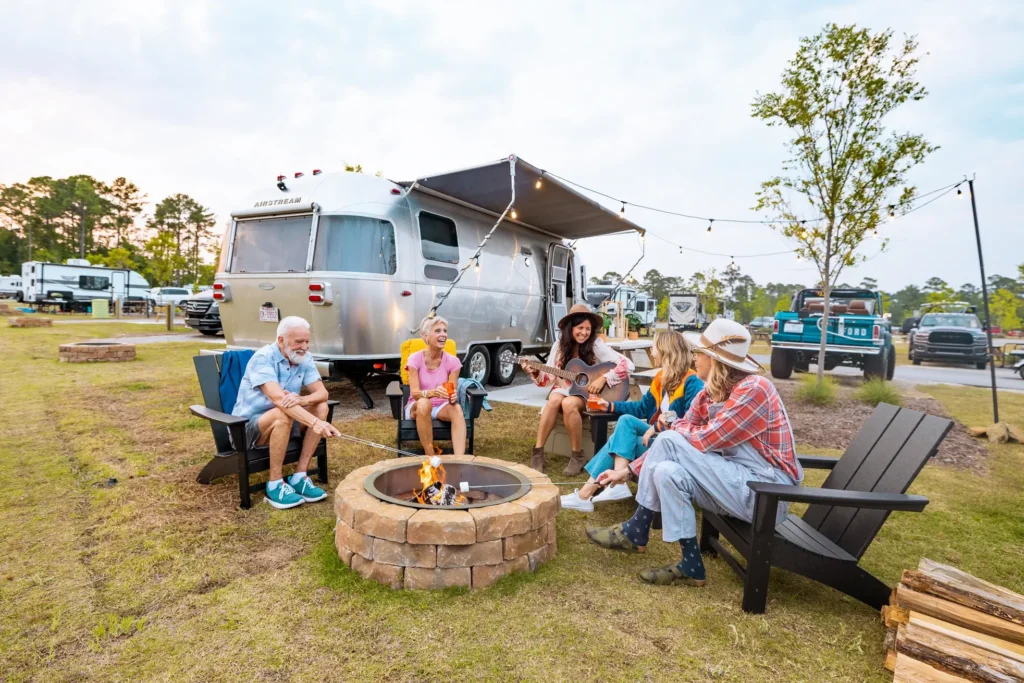
Finding your people happens organically in RV parks. You’ll bond over shared frustrations (the WiFi never works), route comparisons, mechanical troubleshooting, and evening campfires. RV folks look out for each other. Someone will offer to help when you’re struggling to back into a site.
Online communities matter, too:
- Facebook groups for specific RV models, regions, and interests
- Fulltime Families (for traveling with kids)
- Workamper News forums
- Women RVers (RV Women, Wandering Individual Women groups)
- Reddit r/GoRVing and r/FullTiming
Maintaining existing connections takes effort. Schedule regular video calls. Send postcards. Share your location with a private group. Invite people to meet you en route (national parks make great reunion spots).
Couple dynamics intensify. You’ll discover things about your partner you never knew, like how they handle stress when the water pump breaks at 9pm. Arguments have nowhere to go when you can’t storm off to another room. Communication skills aren’t optional here.
Solo RVing requires intentionality about loneliness. Join group rallies. Stay at social campgrounds. Have a daily check-in buddy. Video call friends regularly. Loneliness sneaks up. Address it early.
Choosing Where to Stay
Types of Camping Options
RV resorts and parks ($40-$100/night, or $500-$1,500/month) offer full hookups (water, electric, sewer), WiFi, laundry, pools, clubhouses, and activities. They’re the most expensive camping option, but they provide the most amenities and comfort. These are where you’ll meet other full-timers, attend potlucks, and feel like you have a neighborhood.
The 10-year rule: Some premium RV parks won’t accept RVs older than 10 years, regardless of condition. If you’re buying used, factor this restriction into your campground options.
National and state parks ($20-$50/night) offer incredible locations but with trade-offs: limited hookups (often electric-only or none), strict length-of-stay limits (7-14 days typical), months-advance reservations for popular parks, and spotty cell service. Great for experiencing nature. Not ideal as a home base. Book through Recreation.gov for national parks or Reserve America for state parks.
Boondocking (free-$20/night) is dry camping on public lands (BLM, national forests) or private property with no hookups. Benefits: stunning locations, solitude, and free or cheap stays. Requirements: self-sufficient RV systems (solar, generator, sufficient battery, large fresh water tank), comfort with primitive conditions, and the ability to dump tanks elsewhere.
Apps for finding boondocking spots:
- Campendium: User reviews and cell coverage data
- FreeRoam: BLM and Forest Service sites
- iOverlander: Crowd-sourced free camping spots
- The Dyrt: Campground reviews across all types
Private property (free-$50/night) via Harvest Hosts (wineries, farms, museums), Boondockers Welcome (private driveways), or Hipcamp (private land). Unique experiences, often free with a purchase. Usually 1-night stays with no hookups.
Urban overnighting (free-$20/night): Walmart, Cracker Barrel, casino parking lots. Overnight only, no setup, generally safe, good for transit nights. A tool, not a lifestyle.
Seasonal Migration Strategies
Following the weather is how many full-timers avoid temperature extremes:
- Winter: South Texas, Arizona, Florida, Southern California (60-75°F)
- Spring: Moving north: Texas Hill Country, Tennessee, South Carolina (50-70°F)
- Summer: Mountains and northern states: Colorado, Wyoming, Pacific Northwest (60-80°F)
- Fall: Transitioning south: Utah, New Mexico, Oklahoma (50-70°F)
If you’re planning a longer seasonal route, our cross-country RV trip guide maps out popular loops across the country. And for winter-specific recommendations, check out our best snowbird RV parks.
Tourist season timing creates trade-offs:
- Peak season = crowds + high prices + full campgrounds + advance reservations required
- Shoulder season = comfortable weather + moderate prices + easier bookings
- Off-season = cheap rates + solitude, but some amenities and attractions close
Regional cost variations:
- West Coast: Expensive year-round ($50-$80/night average)
- Southwest: Cheap in summer, expensive in winter
- Southeast: Moderate, spikes near beaches and theme parks
- Midwest: Consistently affordable ($30-$50/night)
What Makes a Great Full-Timer Park
Essential amenities for extended stays:
- Reliable full hookups (50-amp preferred)
- Strong WiFi or excellent cell coverage
- Clean, well-maintained facilities (especially laundry)
- Spacious sites (you’re living here, not just sleeping)
- Reasonable monthly rates ($500-$900 is typical)
- Package acceptance (for online shopping)
- Workspace or community areas
Community atmosphere indicators:
- Potlucks, movie nights, group activities
- Other long-term residents (ask the host: “how many full-timers do you have?”)
- A community fire pit or gathering space
- Friendly staff who know regulars by name
Monthly rate negotiation tips:
- Ask about “monthly rate” vs. nightly×30 (often 20-30% savings)
- Request off-season discounts
- Inquire about work-camping (trade work for a reduced rate)
- Multi-month commitments sometimes earn further discounts
The RJourney approach: Our parks are built with full-timers in mind: spacious sites, genuine community, locations that work for seasonal migration, and staff who understand the lifestyle. Many guests come back year after year, treating RJourney as their home base while exploring the region.
- Extended stay rates ($500-$900/month depending on location and season)
- Monthly rate discounts (typically 20-30% off nightly rates)
- Community events (potlucks, movie nights, group activities)
- Strategic locations along popular migration routes (Colorado parks for summer, Texas parks for winter)
We’re a place to belong. Explore RJourney parks and seasonal rates.
Wondering how an RV park compares to a hotel for longer stays? We broke that down in our RV resort vs. hotel comparison.
Maintenance, Safety, and Problem-Solving

Preventive Maintenance Essentials
Monthly inspection checklist:
- Check tire pressure (including spare)
- Inspect roof for cracks and sealant integrity
- Test all lights (running, brake, turn signals)
- Check propane connections for leaks
- Clean furnace/AC filters
- Lubricate slide-out mechanisms
- Inspect awning for tears, clean fabric
- Test smoke and CO detectors
- Check battery water levels (if not maintenance-free)
- Examine exterior for cracks and delamination
Seasonal preparation:
- Winterization (if going below freezing): Drain water system, add RV antifreeze to lines, protect pipes, cover vents
- De-winterization (spring): Flush antifreeze, sanitize fresh water tank, check for freeze damage
- Summer cooling: Clean AC coils, check coolant, ensure all fans work, consider reflective window covers
Tire management: RV tires have age limits (typically 5-7 years from manufacture date) regardless of tread depth. Check sidewalls for cracks. Maintain proper pressure (usually 80-110 PSI for large RVs). Budget $1,000-$2,000 for a full set.
Roof maintenance: Inspect and reseal every 6-12 months. Most RV leaks start at the roof, and water damage is the #1 RV destroyer. An afternoon on a ladder with a caulk gun every 6 months can save you $10,000 in repairs.
When Things Go Wrong
They will. Often.
Emergency repair resources:
- Mobile RV techs (search “mobile RV repair + [your location]”), often faster and cheaper than shop rates
- RV service centers (book weeks in advance when possible)
- YouTube tutorials (seriously, someone has fixed your exact problem on video)
- RV forums (iRV2, Reddit r/GoRVing: post your issue, get crowd-sourced troubleshooting)
Essential tools to carry:
- Basic socket/wrench set
- Screwdriver set (Phillips and flathead)
- Multimeter (for electrical diagnostics)
- Cordless drill
- Duct tape, zip ties, electrical tape (the RV holy trinity)
- Spare fuses and light bulbs
- Tire pressure gauge and air compressor
- Water pump repair parts
- Awning tie-downs (for wind storms)
DIY vs. professional: Learn to fix simple stuff: toilet flush mechanisms, light fixtures, minor plumbing. Call professionals for electrical issues, major appliance repairs, structural damage, brake systems, anything involving propane lines.
Roadside assistance is essential. Good Sam Roadside Assistance covers RV-specific issues like tire changes on dual wheels and towing for large rigs. Budget $100-$200/year. Don’t skimp on this.
For more on greening your RV setup (solar, efficiency mods, reducing waste), see our eco-friendly camping guide.
Safety and Security
Physical security: A quality security camera (Ring or similar) provides peace of mind whether you’re parked in a busy RV park or boondocking somewhere remote. Keep valuables out of sight. Trust your instincts in unfamiliar areas.
Emergency preparedness: Keep a well-stocked first aid kit. Know the locations of nearby hospitals or urgent care centers at every stop. Have a plan for breakdowns and severe weather. Keep a list of emergency contacts including roadside assistance and local services.
Situational awareness: This matters especially when dry camping on public lands or in unfamiliar areas. Be mindful of your surroundings at night. Familiarize yourself with each campground’s safety procedures and nearest exits. Most fellow travelers are friendly and helpful, but it’s wise to exercise normal caution.
Staying Healthy on the Road
Healthcare access: Most full-timers don’t have a “regular doctor.” Instead: urgent care for acute issues, telehealth for prescriptions and follow-ups, and specialists scheduled during visits to your domicile state or major cities. In small towns and remote areas near national parks, even basic medical services can be sparse. Plan ahead.
Prescription management:
- Use a mail-order pharmacy (ships to your forwarding address or an upcoming campground)
- Request 90-day supplies
- Keep digital copies of all prescriptions
- Know generic names (regional pharmacies may not carry your specific brand)
Telehealth has changed the game for full-timers: video appointments for non-emergency issues, prescription refills, and mental health support. Most insurance covers it. Use it.
Fitness and nutrition: Limited space means creativity: resistance bands, yoga, bodyweight exercises, hiking. Small fridges mean more frequent grocery trips and less meal prep capacity. Crockpots and Instant Pots are RV kitchen MVPs.
Making Full-Time RVing Sustainable
Avoiding Burnout
Road fatigue is real. Symptoms: dreading the next move, irritability, longing for a “normal” kitchen, feeling exhausted despite not doing much, losing excitement about new places.
When to slow down:
- You’re moving every 2-3 days and feeling exhausted
- You’re spending more time setting up/tearing down than enjoying locations
- Your relationship is strained
- Work performance is suffering
Building in rest and recovery:
- Stay put for a month somewhere comfortable
- Take a “vacation from your vacation” (book a hotel for a weekend; enjoy a full-size shower)
- Skip tourist activities. Permission to do nothing.
- Reconnect with why you started
Reassessing and adjusting: Your first plan won’t be your final plan. Maybe you discover you hate moving constantly and prefer a home base + day trips model. Maybe you love the nomadic life but need shorter stretches. Maybe seasonal full-timing (6 months on, 6 months off) works better than year-round. Adjust without guilt.
Long-Term Considerations
Aging in an RV is doable but requires planning. Can you navigate RV steps as you get older? What if you need medical equipment that takes up space? Some full-timers transition to park models (permanent RVs on foundations) or downsize to Class B vans for easier accessibility.

Exit strategies aren’t failures. Maybe full-timing is a 2-year adventure before returning to traditional housing. Maybe it’s seasonal (snowbird 6 months, house 6 months). Maybe you do it until grandkids arrive. Knowing your off-ramp removes the pressure to make this “forever.”
Financial planning beyond the road:
- Keep retirement accounts growing
- Don’t cash everything out to buy an RV
- Have a plan for when you’re ready to stop
- Consider: will you return to the housing market? Where? Budget accordingly.
How the lifestyle evolves:
- Year 1: Constant movement, tourist mode, high excitement
- Year 2: Settling into rhythms, finding favorite places, less novelty-seeking
- Year 3+: Slower travel, home base strategies, deeper community connections
This evolution is normal. Full-timing at year 1 looks nothing like year 5. Give yourself permission to change your approach as you learn what works.
For inspiration on where to plant roots along the way, browse our best RV parks across 19 states.
Frequently Asked Questions
How much does it cost to live full-time in an RV?
Most full-timers spend $2,000-$5,000/month depending on travel style. Boondocking minimalists can live on $2,000-$2,500. Comfortable RV resort stays with dining out run $3,500-$5,000. Luxury full-timing can exceed $8,000/month. Major costs: campground fees, fuel, groceries, insurance, and maintenance.
Can you work remotely from an RV?
Yes, and many full-timers do. Requirements: reliable internet (cellular hotspot + booster minimum, Starlink for rural areas), quiet workspace, and the ability to meet deadlines despite connectivity challenges. Best careers: software development, writing, consulting, virtual assistance, anything location-independent. Expect to invest $500-$1,500 in connectivity equipment.
What’s the best RV for full-time living?
Fifth wheels (30-40 feet) are most popular for couples and families, offering space, storage, and livability. Class A motorhomes work for those prioritizing ease of movement. Solo travelers often prefer Class B vans for versatility. The “best” RV depends on how often you move, your budget, whether you need a separate bedroom, and if you want to unhitch for exploring. Always test before buying.
How do you get mail when living in an RV?
Use a mail forwarding service like Escapees, Americas Mailbox, or Traveling Mailbox. They provide a physical address, scan your mail, and forward items on request. Cost: $15-$50/month depending on volume. This address also serves as your domicile for legal purposes (taxes, voting, licenses).
Is full-time RVing cheaper than owning a home?
Sometimes. A paid-off RV boondocking on public lands costs less than most mortgages. But financing a new RV while staying in expensive resorts can match or exceed housing costs. The real answer: it depends on your choices and region. Budget $2,000-$5,000/month for comfortable full-timing. You’ll eliminate property taxes and homeowners insurance, but you’ll add fuel costs and campground fees.
Where can you park an RV full-time?
Options include RV resorts and parks ($40-$100/night), national/state parks ($20-$50/night but with limited stays), boondocking on public lands (free or cheap), private property via Harvest Hosts (varies), and overnight stops (Walmart, etc.). Most full-timers mix all of these. Apps like Campendium, The Dyrt, and FreeRoam help find spots. Expect to move every 7-14 days unless paying for monthly sites.
How do you handle healthcare while RVing full-time?
Use urgent care for acute needs, telehealth for routine care and prescriptions, and travel to your domicile state or major cities for specialists. Keep digital medical records. Many full-timers carry ACA marketplace insurance ($300-$800/month per person) or Medicare with supplemental coverage. Mail-order pharmacies ship prescriptions to your forwarding address or upcoming campground.
What are the biggest challenges of full-time RVing?
Common challenges: maintaining relationships in close quarters, dealing with constant repairs, managing homesickness or loneliness, navigating seasonal weather, staying connected with unreliable internet, and handling the emotional weight of a major lifestyle change. The 3-3-3 rule helps: drive no more than 300 miles/day, arrive by 3 PM, stay 3+ days minimum.
What is the RV 10-year rule?
Some RV parks prohibit RVs older than 10 years from staying on their property, regardless of condition. This affects purchasing decisions: if you buy used, you may face restrictions at premium campgrounds. Always check park policies before booking, and factor this into your new vs. used decision.
What is the 3-3-3 rule for RVing?
Drive no more than 300 miles in a day. Arrive at your destination by 3 PM. Stay for at least 3 days. This prevents burnout, allows time for setup without stress, and lets you actually enjoy each location rather than always being in transit. Following this rule dramatically improves full-timing sustainability.