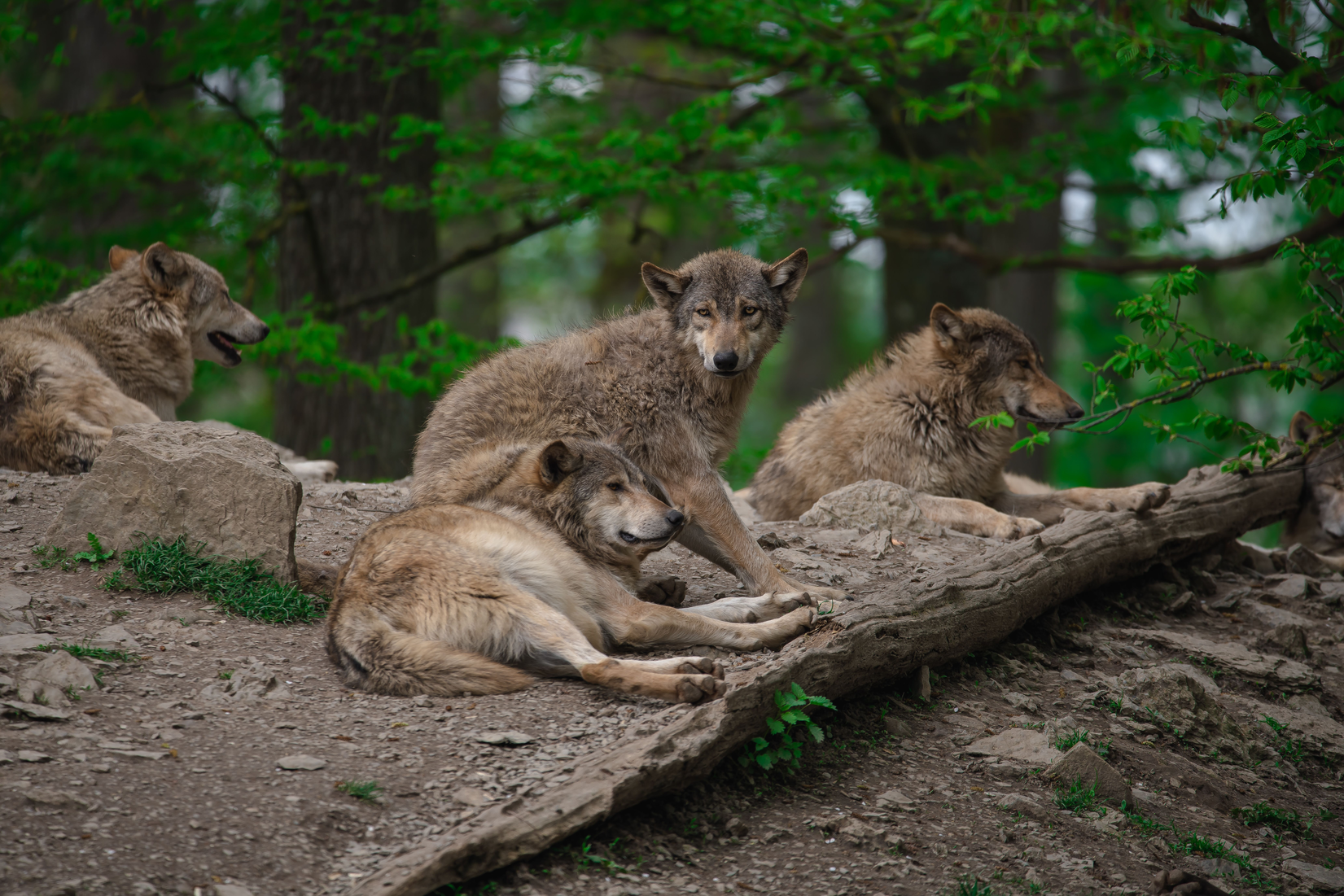
The wolf pack hierarchy most people picture, with an alpha at the top and an omega at the bottom, rarely describes wild wolves. A wild pack is a family. A breeding pair raises their pups, and the older offspring stay on to help for a year or two before they leave to start families of their own.
That correction matters if you camp in wolf country. Knowing how a pack is built helps you read what you see and hear, and it explains why a wolf near your site is usually a young animal passing through.
Here is how a pack works, where the popular rank labels came from, and what it means for your campsite.
Hierarchy of Wolf Packs
Short answer: the wolf pack hierarchy in the wild is a family tree. Packs average 5 to 9 members, and nearly all of them are related. The core is a breeding pair, plus their offspring from the past one to three years.
The words alpha, beta, and omega come from studies of captive wolves, where unrelated adults were housed together and had to sort out who ranked where. Wolf biologist L. David Mech popularized “alpha” from that work. After years of watching wild packs, he published Mech’s 1999 paper on alpha status and reversed himself: in the wild, the so-called alphas are simply the parents. They lead because they are mom and dad.
Rank among the offspring still exists, but it follows age and breeding status. Older siblings tend to outrank younger ones, much like a human family with several kids. That is a hierarchy of age and experience, and it looks nothing like a ladder of rivals.
The Breeding Pair (Formerly “Alpha”)
One male and one female breed and raise the pups. They usually decide when the pack travels, where it rests, and when it hunts, and they often eat first. Their authority comes from being the parents. When one of them dies, the survivor typically pairs with a new mate, or an older offspring takes the vacant spot.
Older Offspring (Formerly “Beta”)
Yearlings and young adults sit just below the parents. They help hunt, guard the territory, and look after the pups. Most will leave. Young wolves disperse between roughly 1 and 3 years old to find a mate and found a pack of their own. A lone wolf wandering through a campground area is often one of these dispersers, and it can cover many miles in a few days.
Younger Siblings
Last year’s pups follow the older wolves, learn hunting routes, and play a lot. Play-fighting and body language sort out who gets which spot at a kill, but nobody holds a formal rank. Pack life stays calm because the wolves know each other well.
Why There Is No “Omega” or “Delta”
The omega label came from captive groups, where one low-ranking animal took most of the aggression. Wild families do not run that way. “Delta” is not a scientific term at all, so you will not find it in the research. If you see a wolf picked on in a pack, it is far more likely an unwell animal or a young one learning limits.
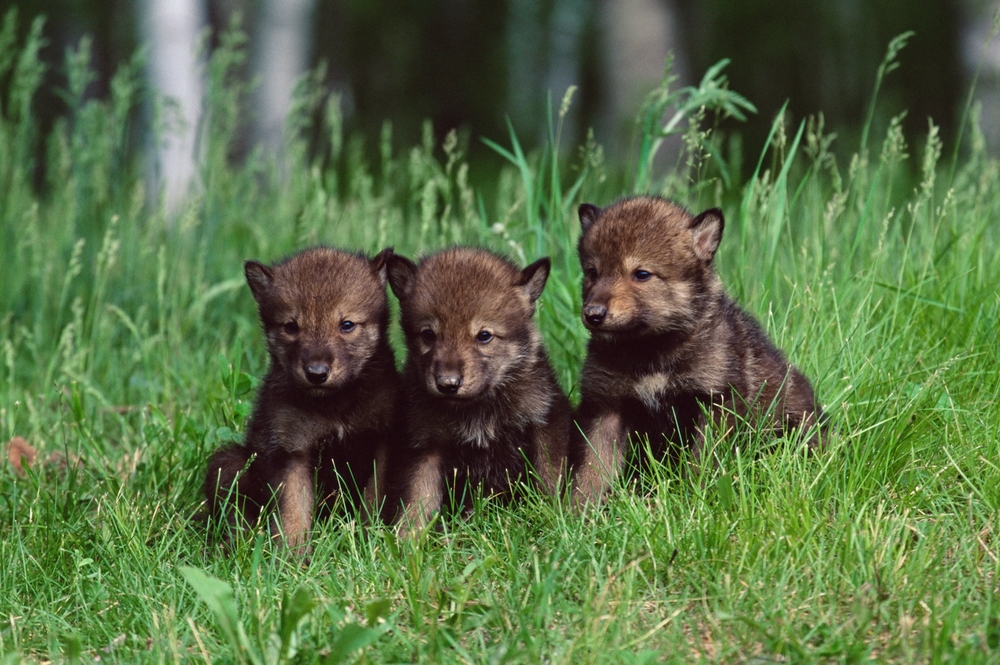
Wolf Pups
Pups are born in spring and raised by the whole family. The parents do not assign pups a rank. Pups find their place through play, size, and age, and every adult in the pack helps feed and guard them. By their first winter they travel with the pack.
Types of Wolves
The pack structure and rank dynamics above apply across all wolf species. These are the ones you’re most likely to encounter in North America.
Gray Wolf. The largest member of the wild dog family. Adults weigh 70 to 150 pounds, with males in northern populations occasionally exceeding that. Gray wolves travel in packs of up to 12, sometimes more. Their coat color varies widely (silver, black, white, brown, and every mix between), which is part of why people sometimes mistake subspecies for separate species entirely.
Gray wolves were once the most widely distributed land mammal in the Northern Hemisphere. Their range in the lower 48 was reduced to near-nothing by the mid-20th century, but recovery efforts (most visibly the 1995 Yellowstone reintroduction) have rebuilt populations across Wyoming, Montana, Idaho, Oregon, and Washington. The Yellowstone reintroduction is one of the most studied wildlife management events in history, and it reshaped not just the wolf population but the entire ecosystem. Fewer elk, wary of wolves when they were active, let willow and aspen rebound in some streamside areas, though biologists still debate how much credit wolves deserve. Biologists call this a trophic cascade. It started with 31 wolves.
Eastern Timber Wolf. Smaller than the western gray wolf, with reddish-brown coloring and tighter pack configurations of 5 to 7 members. Timber wolves are adapted to dense forest environments and tend to hunt whitetail deer rather than the elk and bison that western gray wolves target. The hunting style reflects the terrain: ambush in heavy cover, tight coordination through dense brush, patience over speed.
Minnesota holds the largest timber wolf population in the lower 48, roughly 2,500 wolves. Wisconsin and Michigan have established populations as well, with numbers that have grown steadily since federal protections were enacted. Timber wolf packs tend to hold smaller territories than their western counterparts because prey density in Great Lakes forests supports more wolves per square mile.
Great Plains Wolf. Once the most wide-ranging North American gray wolf subspecies, stretching from southern Canada to Texas. Great Plains wolves are adapted to open grassland and mixed prairie, where they historically followed bison herds across enormous distances. Their pack structure reflects that nomadic lifestyle: slightly smaller packs (5 to 6 members on average) with flexible territory boundaries that shifted with prey migration.
Habitat loss and predator control programs nearly eliminated the subspecies by the early 1900s. Current populations exist primarily in the northern U.S. and Canada, though their genetic legacy is mixed into many of the gray wolf populations that have been reintroduced or have naturally recolonized across the northern Rockies and Great Lakes.
Mexican Gray Wolf. The smallest and most genetically distinct North American gray wolf subspecies, weighing 50 to 80 pounds. Mexican gray wolves were declared extinct in the wild by the 1970s. A captive breeding program starting with just 7 founder animals kept the subspecies alive, and reintroduction began in Arizona’s Blue Range in 1998.
Recovery has been slow but consistent. The wild population reached 319 wolves across Arizona and New Mexico by 2025, marking 10 consecutive years of growth. At least 60 packs were documented, with 37 in New Mexico and 23 in Arizona. Sightings remain genuinely rare, though individual wolves have been documented dispersing into central Arizona’s Coconino National Forest, well beyond the traditional recovery boundaries. The genetic bottleneck from those 7 founders remains a concern: the population’s mean kinship score sits at 0.24, just below the 0.25 threshold for full siblings.
Where Do Wolves Live?
Forests, mountains, and tundras. Wolves den near boulder outcroppings, under fallen trees, or in hillside caves. The same den site is used by multiple generations of the same pack.
From a camper’s vantage point, encounters are most likely near rivers, meadows, and forest edges where deer and elk congregate. These are the transition zones between cover and open ground, exactly where prey animals feed and where wolves position themselves for the approach. Early morning and dusk are peak movement windows.
Camping in Wyoming, Montana, Minnesota, Wisconsin, Oregon, or Washington puts you in wolf-possible territory. In Oregon alone, the wolf population surpassed 200 for the first time in 2024, with 25 documented packs spread across the eastern and western parts of the state. That’s worth a few minutes of research before you arrive.
What Do Wolves Eat?
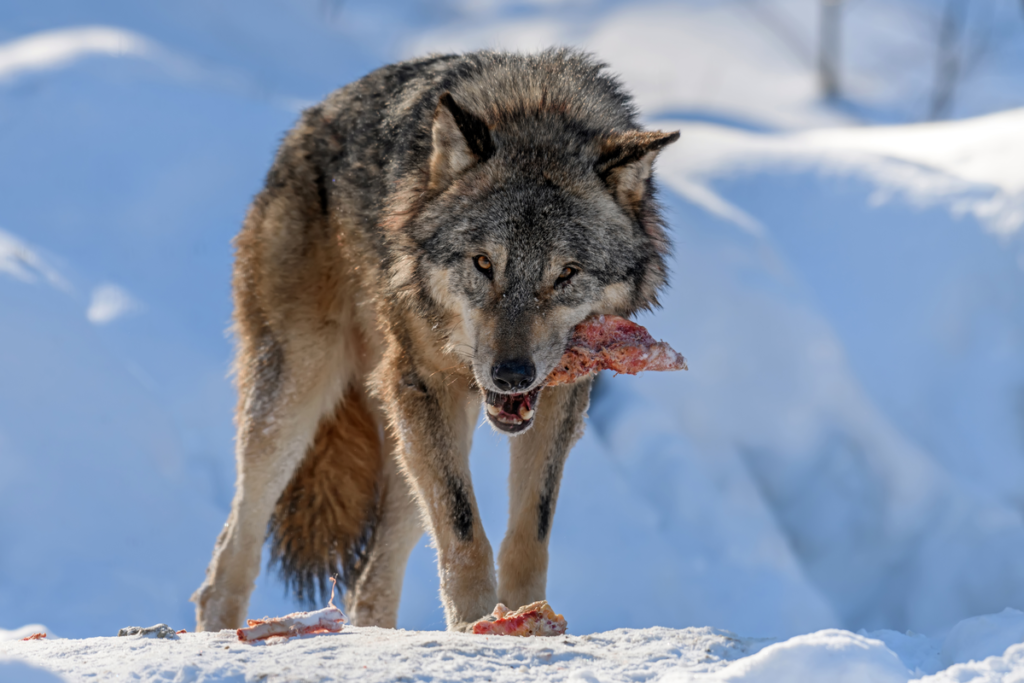
Wolves are carnivores that target large hoofed animals: elk, deer, moose, bison. A single adult wolf can consume up to 20 pounds of meat in one feeding. When large prey isn’t available, they scavenge, and occasionally hunt smaller game like beavers and rabbits.
The pack hunts cooperatively, and the roles described above play out in real time during a chase. Alphas direct the approach. Deltas run the flanks. The pack tests multiple prey animals before committing to one, looking for signs of weakness: a limp, age, separation from the herd. Most hunts fail. Estimates put the success rate for wolf hunts at roughly 10 to 15%, which means the pack spends far more time searching and testing than actually catching anything.
Food smell is what draws wolves toward campsites. It’s rarely anything more complicated than that.
How Do Wolves Communicate?
Body language comes first, vocalizations second. A tail held high signals dominance. Bared teeth without sound is a warning. Ears back and body low signals submission. Wolves read each other’s posture constantly, making micro-adjustments to their own body language dozens of times in a single interaction. Most of the pack’s social negotiation happens without any sound at all.
Howling is what most people notice, and for good reason. A wolf’s howl can carry 6 to 10 miles in open terrain. Packs howl to locate separated members, reinforce social bonds before a hunt, and warn rival packs away from claimed territory. Each wolf’s howl has a distinct pitch, which means individual wolves can be identified by their voice alone. Researchers use this to track pack composition without visual contact.
If you hear howling from your campsite, the pack knows you’re there. They’re talking to each other. You’re just within range of a very loud conversation.
How To Keep Wolves Away From Your Campsite
Wolf encounters at campsites are uncommon. The right habits make them rarer still.
- Store all food in sealed containers or a bear box. Never in your tent.
- Cook away from your sleeping area when possible.
- Pack out all food waste and trash completely.
- Make noise when moving through dense brush at dawn or dusk.
- Research your specific area before arrival. Ranger stations publish recent wildlife activity, and it’s worth a quick read before you set up camp.
- Pick a well-maintained campsite with established food storage infrastructure.
If you do see a wolf: give it distance, hold your ground calmly, and let it move on. Wolves in North America rarely hold their ground against a calm, upright human.
Camp Near Wolf Country
Some of our parks sit in or near territory where wolf populations have recovered and stabilized. We don’t lead with this, but it’s worth knowing before you choose your base.
Laramie RV Resort in Wyoming puts you in the state that hosted one of the most closely studied wildlife reintroductions in history. Packs from the Greater Yellowstone Ecosystem range well beyond park boundaries into surrounding national forests, including Medicine Bow-Routt to the southeast.
Baraboo RV Resort in Wisconsin gives you access to the broader state park network and the wooded stretches where wolf sightings get reported. Wisconsin’s wolf population has grown steadily across the northern forests for 2 decades.
Klamath Falls RV Resort in Oregon puts you in a state where the wolf population just crossed 200 for the first time since the 1940s. Eastern Oregon holds the densest packs, but wolves have been documented in the Cascades and even western valleys. The landscape around Klamath Falls (high desert meeting conifer forest, with elk and deer corridors running through it) is exactly the transition habitat wolves gravitate toward.
No guaranteed sightings. But these are the regions where the probability goes from hypothetical to real.
Find Your Park
If camping where wolves actually live sounds like the right kind of trip, we can help with the logistics. Check availability at our parks across Wyoming, Wisconsin, and Oregon, or explore the full RJourney network to find the right base for your route.