You can’t overstate how useful it is to know your RV’s exact length, though what you might find really impossible to deal with is the stress of arriving at a campsite that you’d booked only to find out later that your rig is too big for the spot. Whether you’re just starting to hit the road with your first RV park booking or you’ve got years of travel under your belt, having a clear grasp of how to measure your RV length properly is something that will give you a huge amount of peace of mind every time you book a site.
But here’s the thing, your RV manufacturer’s specs just aren’t the whole story. That “28-foot travel trailer”, for instance, might in reality need a 35-foot site to fit all your gear in, thanks to the bike rack, tow vehicle, and clearance you need to set up.
This guide will take you through the exact steps to measure your RV setup, and explain why adding extra space in to account for all the bits and bobs you’ve got hanging off the back is so important. It’ll also help you explain your needs to RV park folk when booking across the country.
Why Accurate RV Length Measurement Matters
Booking an RV site that’s too small creates problems that can derail your entire trip. Parks like Bryce Canyon RV Resort and Cedar City RV Resort carefully design their sites to accommodate specific RV lengths, but they rely on accurate information from guests.
The Real Cost of Getting It Wrong
When you underestimate your RV length, you might face:
- Denied entry – Some parks strictly enforce length restrictions and may turn you away
- Unsafe setup – Extending slideouts into roadways or over neighboring sites
- Damaged equipment – Tight turns and cramped spaces lead to scraped awnings and bent stabilizers
- Added fees – Last-minute upgrades to larger sites often cost more
- Relationship stress – Few things test patience like trying to shoehorn a too-large RV into a too-small space
Understanding how to measure your RV length correctly prevents all of these headaches and ensures you’re matched with the perfect site every time.
The Problem with Manufacturer Specifications
Your RV’s model name or manufacturer specs don’t tell you what campgrounds actually need to know. Here’s why those numbers fall short:
Manufacturer length includes only the RV body – It measures from the front bumper (or hitch) to the rear bumper, excluding anything that extends beyond like bike racks, spare tire carriers, or cargo boxes.
Model names are often rounded – That “Winnebago 32-foot” might actually be 32 feet 8 inches, and those extra inches matter when sites are measured precisely.
Tow vehicles aren’t included – If you’re pulling a travel trailer or fifth wheel, the manufacturer length doesn’t account for your truck taking up several additional feet.
Slideouts can affect maneuvering – While slideouts don’t increase your travel length, they impact how much space you need once parked.
RV parks need your total setup length—the complete measurement from the very front of your tow vehicle (or motorhome) to the absolute furthest point on the back of your rig.
How to Measure Your RV Length: Step-by-Step
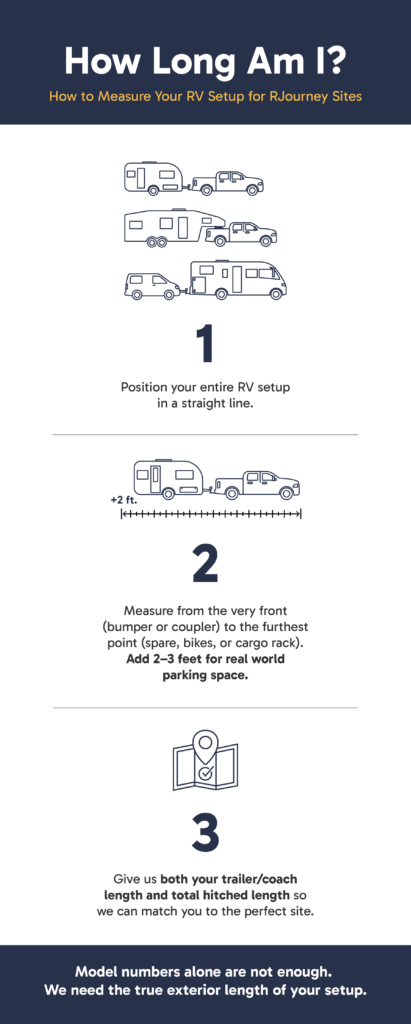
Follow these three simple steps to get an accurate measurement that ensures perfect site selection every time you book.
Step 1: Position Your Entire RV Setup in a Straight Line
Park your complete travel setup exactly as you’d arrive at a campground. This means:
- Motorhomes: Park on level ground with any tow vehicle (toad) attached if you travel with one
- Travel trailers: Connect your trailer to your tow vehicle with the hitch locked and weight distribution bars engaged
- Fifth wheels: Connect your fifth wheel to your truck with the kingpin locked into the hitch
Make sure everything is aligned straight. Any angle between your tow vehicle and trailer will give you an inaccurate measurement.
Step 2: Measure from Front to Back, Including Everything
Start measuring from the absolute furthest point forward on your setup. This means:
- The front bumper of your tow vehicle (for travel trailers)
- The front bumper of your truck (for fifth wheels)
- The front bumper or hitch of your motorhome
Measure to the furthest point back, which might be:
- A rear-mounted spare tire
- A bike rack with bikes attached
- A cargo carrier
- A ladder
- Your rear bumper (if nothing extends beyond it)
Use a long measuring tape or—for an easier approach—drive your setup past a fixed point and mark where the front and back align, then measure between the marks.
Critical: Add 2-3 feet to your measurement for real-world parking space. This buffer accounts for maneuvering room, allows comfortable access around your RV, and prevents your setup from hanging over the site boundaries. Most RV parks design their sites with this buffer in mind, but you need to account for it when stating your length.
Step 3: Provide Both Measurements When Booking
When contacting RV parks, provide two numbers:
- Your trailer/coach length alone – This is the RV body measurement without the tow vehicle
- Your total hitched length – This is your complete measurement including everything
For example: “I have a 28-foot travel trailer. My total setup length with my truck is 52 feet.”
Providing both measurements helps RV park staff at properties like Cortez RV Resort and Lakeside RV Resort match you to the ideal site. Some parks list site lengths based on RV-only measurements while others specify total setup capacity.
Common RV Length Measurement Mistakes to Avoid
Even experienced RVers sometimes get their measurements wrong. Watch out for these frequent errors:
Mistake 1: Measuring Without Accessories
Removing your bike rack or cargo carrier before measuring gives you a false number. Always measure with everything you’ll actually travel with installed.
Mistake 2: Forgetting the Tongue Extension
Travel trailers with long tongue extensions (the A-frame that connects to the hitch) can add several feet to your total length that’s easy to overlook.
Mistake 3: Rounding Down
If your measurement comes to 38 feet 7 inches, don’t book a 38-foot site hoping it will work. Round up to 40 feet to ensure adequate space.
Mistake 4: Ignoring Slide-Out Clearance
While slideouts don’t affect your length, they do affect site width. When booking, mention if you have multiple slideouts so the park can ensure adequate side-to-side space.
Mistake 5: Trusting Outdated Measurements
Added a new bike rack? Upgraded to a larger spare tire carrier? Changed tow vehicles? Remeasure. Your setup changes, and so should your stated length.
How RV Length Affects Site Selection
Understanding your RV length helps you make smarter booking decisions across different types of RV parks and campgrounds.
Site Length Categories
Most RV parks categorize sites by length ranges:
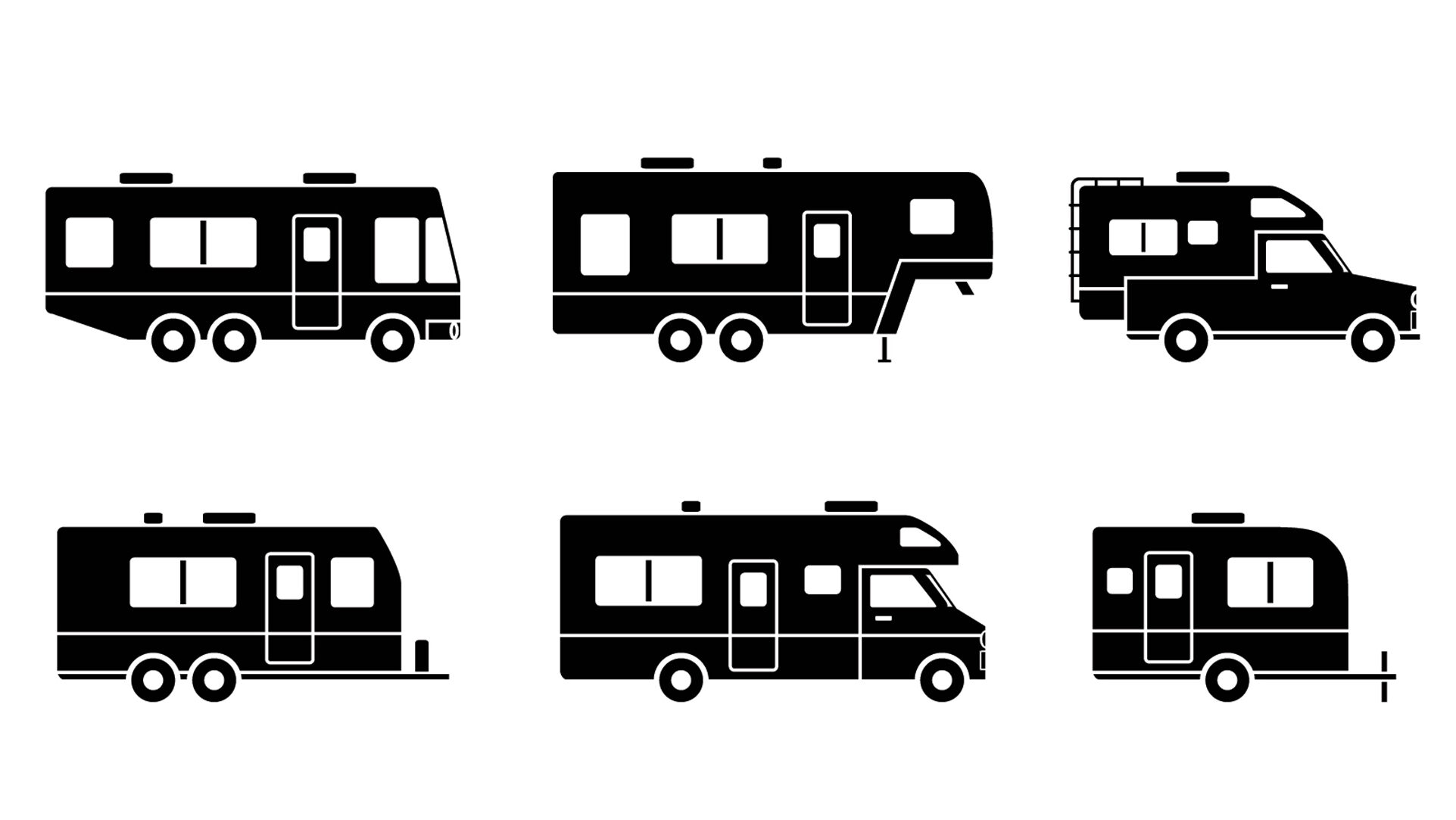
- Small sites (20-30 feet) – Best for small travel trailers, truck campers, and Class B motorhomes
- Medium sites (30-40 feet) – Accommodate most travel trailers and smaller fifth wheels
- Large sites (40-50 feet) – Handle larger fifth wheels and Class A motorhomes
- Extra-large sites (50+ feet) – Designed for luxury coaches and long trailer setups
Properties like Cheyenne RV Resort and Laramie RV Resort offer various site sizes to accommodate every type of RV, but you need to know your length to choose correctly.
Pull-Through vs. Back-In Sites
Pull-through sites typically accommodate longer RVs more easily since you don’t need to unhitch or maneuver in reverse. If your setup exceeds 40 feet, requesting a pull-through site makes arrival and departure significantly easier.
Back-in sites work perfectly well for most RVs but require more maneuvering skill with longer setups. If you’re new to RVing or traveling with a particularly long rig, mention this when booking so staff can recommend the most manageable site.
Special Considerations for Different RV Types
Different RV configurations have unique measurement considerations.
Travel Trailers
Key measurement: Hitch coupler to rear bumper (or furthest rear point)
Don’t forget: Your tow vehicle adds 18-22 feet typically
Buffer needed: 3 feet minimum for tongue clearance and rear accessories
Fifth Wheels
Key measurement: Front of truck to rear of fifth wheel
Don’t forget: The portion of the fifth wheel that extends over the truck bed doesn’t add length, but measure from your truck’s front bumper
Buffer needed: 2-3 feet for overhang clearances
Class A Motorhomes
Key measurement: Front bumper to rear bumper (or furthest point)
Don’t forget: Towing a vehicle adds its entire length plus the tow bar
Buffer needed: 2 feet minimum, more if towing
Class C Motorhomes
Key measurement: Front cab to rear
Don’t forget: Roof-mounted accessories and rear-mounted bike racks
Buffer needed: 2 feet for comfortable setup
Class B Campervans
Key measurement: Usually straightforward bumper-to-bumper
Don’t forget: Roof racks, awnings, and rear-mounted cargo
Buffer needed: 1-2 feet (these are more forgiving)
Communicating Your RV Length When Booking
When you call or book online at RV parks, use this script template for clarity:
“I’m booking a site for [dates]. I have a [RV type and brand] that’s [manufacturer length] feet. My total setup length including [tow vehicle/towed vehicle/accessories] is [total measurement] feet. I have [number] slideouts. Do you have a site that can accommodate this comfortably?”
For example:
“I’m booking for July 15-20. I have a Grand Design fifth wheel that’s 35 feet. My total setup length including my F-350 is 52 feet. I have three slideouts. Do you have a site that can accommodate this comfortably?”
This gives RV park staff all the information they need to match you with the perfect site at properties throughout the RJourney network.
Why the 10-Foot Rule Matters
Most RV experts recommend booking sites that are at least 10 feet longer than your total measured length. Here’s why this buffer is so valuable:
Comfortable maneuvering – Extra space means less stress during setup and departure
Utility hookup access – Ensures you can position your RV to easily reach water, electric, and sewer connections
Neighbor courtesy – Prevents your rig from encroaching on adjacent sites
Slideout operation – Gives you room to fully extend slideouts without interference
Storage access – Ensures you can access rear storage compartments and basement bays
For a 40-foot total setup, booking a 50-foot site provides ideal comfort and convenience.
Real-World Examples
Example 1: Travel Trailer Setup
- 2022 Keystone 28-foot travel trailer
- Chevy Silverado 2500 tow vehicle (20 feet)
- Rear-mounted bike rack with two bikes (adds 3 feet)
- Total measurement: 51 feet
- Recommended site: 55-60 foot site
- Perfect matches: Elkhart RV Resort or James Creek RV Resort large sites
Example 2: Fifth Wheel Setup
- 2023 Forest River 36-foot fifth wheel
- Ford F-450 (22 feet from bumper to bed)
- Total measurement: 58 feet (fifth wheel overhangs truck bed)
- Recommended site: 65+ foot site
- Perfect matches: Grand Lake O’ the Cherokees premium sites
Example 3: Class A Motorhome with Toad
- 2021 Tiffin 38-foot Class A
- Jeep Wrangler towed vehicle (15 feet)
- Tow bar (adds 2 feet)
- Total measurement: 55 feet
- Recommended site: 60-65 foot site
- Perfect matches: Lake Charles RV Resort or Rockport RV Resort large pull-through sites
Frequently Asked Questions
Do I need to include my slideouts in my length measurement?
No. Slideouts extend perpendicular to your RV’s length and don’t affect how much front-to-back space you need. However, always mention that you have slideouts when booking so the park can ensure adequate side-to-side clearance.
What if my RV length is between two site size categories?
Always book the larger size. A 36-foot RV fits comfortably in a 40-foot site, but will be cramped in a 35-foot site. The extra room is worth the typically small price difference.
Can I unhitch my trailer to fit in a smaller site?
While possible, this isn’t recommended. You’ll need somewhere to park your tow vehicle, and many RV parks have limited extra parking. Additionally, reconnecting for departure adds complexity. Book a site sized for your complete setup.
How do I measure if I don’t have a long enough tape measure?
Drive your complete setup past a landmark like a fence or building. Mark where your front bumper and rear-most point align with the landmark. Then measure between those two marks with a standard tape measure.
Should I remeasure if I change tow vehicles?
Yes. Different trucks have different lengths. A crew cab long bed might be 3-4 feet longer than a regular cab short bed. Always remeasure when any component of your setup changes.
Do RV parks verify length when I arrive?
Most don’t measure, but if your RV clearly exceeds the site capacity, you may be asked to move to a different site (if available) or could be refused entry. Accurate reporting protects everyone.
Ready to Book Your Perfectly Sized Site?
Now that you know how to measure your RV length accurately, you’re ready to book with confidence at any RV park across the country. Understanding your true setup length eliminates arrival-day stress and ensures you’ll always have comfortable space for your rig.
When you’re ready to plan your next adventure, explore RJourney’s nationwide network of RV parks and resorts. From compact sites perfect for weekend getaways to spacious pull-through sites designed for the largest luxury coaches, RJourney properties offer accommodations sized for every RV.
Not sure which RV park is right for your travel style? Read our complete guide on how to choose an RV park to discover what amenities, locations, and features matter most for your next trip.
Model numbers alone are not enough. We need the true exterior length of your setup. Measure correctly, book confidently, and enjoy stress-free RV travel at RJourney parks from coast to coast.