Wyoming has 97,818 square miles of land and about 577,000 people. That works out to roughly 5.8 people per square mile, making it the least densely populated state in the lower 48.
What fills all that space? Public land. Nearly half of Wyoming, about 48%, is managed by federal and state agencies. National parks, national forests, BLM land, state parks, and wilderness areas stretch across the state in a patchwork that’s genuinely unlike anywhere else in the country.
Here’s what’s out there and how to experience it.
National Parks
Wyoming has 2 of the most visited national parks in the system, and they’re both worth the attention they get.
Yellowstone National Park
Yellowstone was the first national park on Earth, designated in 1872, and it still feels like it belongs to a different planet. The park sits on an active supervolcano that powers over 10,000 thermal features: geysers, hot springs, mud pots, and fumaroles scattered across 2.2 million acres.
What to see: Old Faithful is the obvious one, erupting every 90 minutes or so with a reliability that’s earned its name for 150 years. But the real show is the Grand Prismatic Spring, the largest hot spring in North America at 370 feet across. The colors (orange, yellow, green, blue, radiating outward from the center) come from heat-adapted bacteria called thermophiles. Each color band represents a different temperature zone and a different microbial community. The artificial-looking colors are entirely biological.
The Lamar Valley is the best place in the lower 48 to see gray wolves in the wild. Dawn and dusk are prime viewing times. Bring binoculars and patience. The wolves were reintroduced in 1995, and the valley’s ecosystem has visibly transformed since. For more on wolf pack behavior and dynamics, see our wolf pack hierarchy guide.
When to go: June through September for the main season. July and August are peak, with up to 4 million total annual visitors. September thins the crowds considerably while keeping most roads and facilities open. Winter access is limited to the north entrance from Gardiner, Montana, but snowcoach and snowmobile tours reach the interior.
Practical: The park’s 5 entrance gates each charge $35 per vehicle (7-day pass). The Annual America the Beautiful Pass ($80) covers all national parks and is worth it if you’re visiting more than 2 parks in a year. Cell service is minimal inside the park. Gas is expensive and limited. Fill up before entering.
Grand Teton National Park
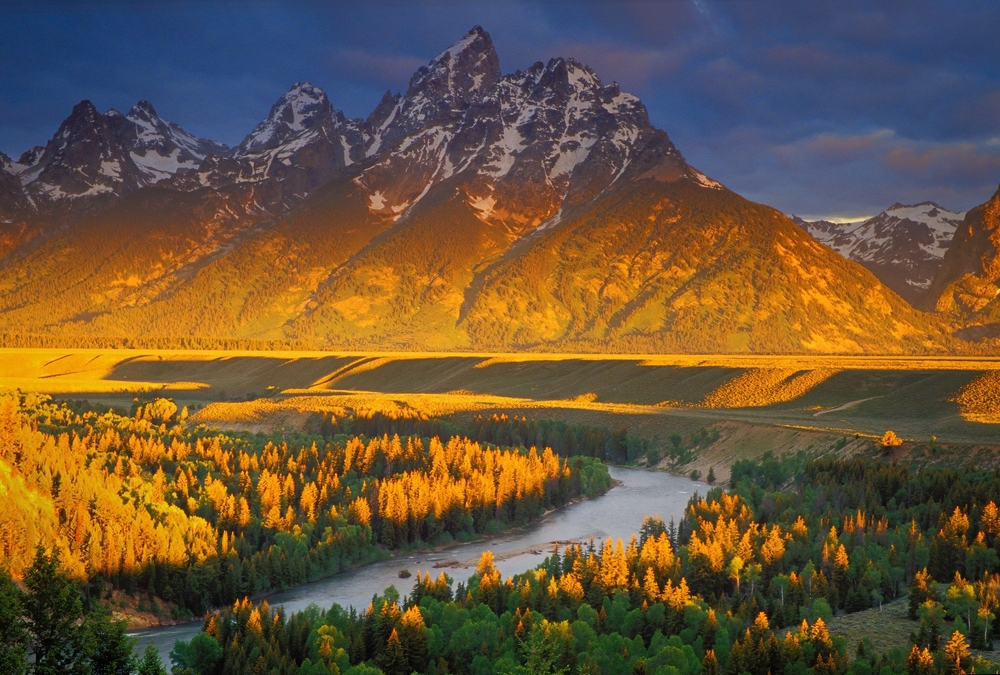
Grand Teton sits immediately south of Yellowstone, and where Yellowstone is sprawling and varied, Grand Teton is focused. The Teton Range rises 7,000 feet above the valley floor with no foothills. That means you get the full visual impact from almost anywhere in the park: 40 miles of jagged peaks reflected in glacial lakes with nothing in between.
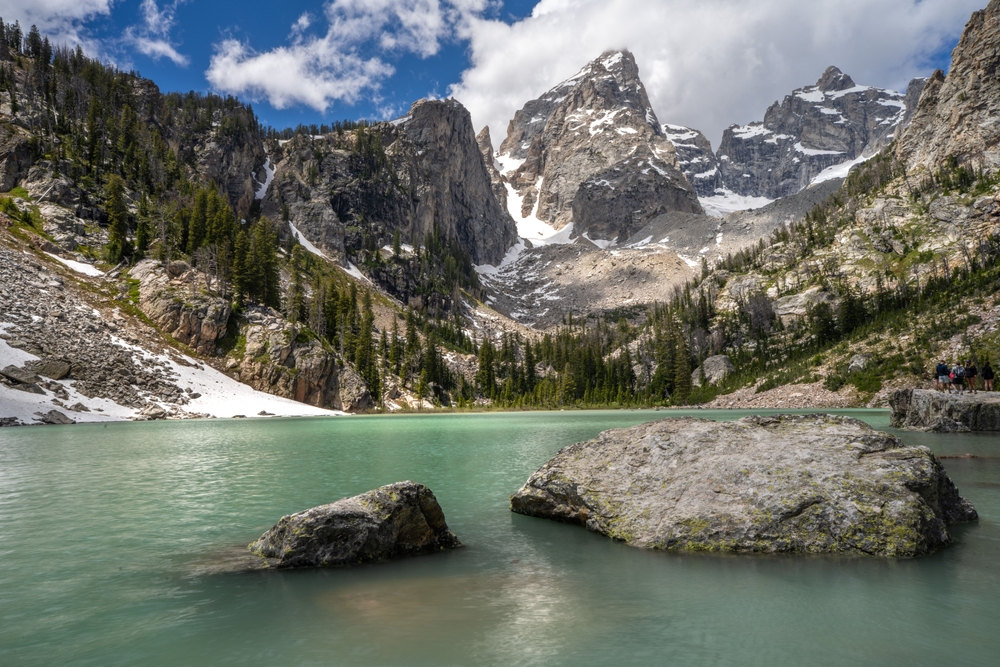
What to see: The Cathedral Group (Grand Teton at 13,775 feet, Mount Owen, and Teewinot) is the centerpiece. Jenny Lake is the most accessible alpine lake for hiking and kayaking. The Cascade Canyon Trail from Jenny Lake to Inspiration Point (5.4 miles round trip, 700 feet of gain) gives you the best scenery-to-effort ratio in the park.
For wildlife: moose are common along the Moose-Wilson Road and in willow flats near Jackson Lake. Bison herds graze the sagebrush flats of Antelope Flats Road. Bears (both black and grizzly) are present; carry bear spray on all hikes and know how to use it. See our guide to black bear safety for campers for specific protocols.
When to go: Late June through September. July and August for wildflowers. September for golden aspens and thinner crowds. The Teton Park Road closes seasonally (usually November through April), but the highway through the park stays open year-round.
National Forests
Wyoming’s national forests get a fraction of the visitors that Yellowstone and Grand Teton draw, but the scenery holds up. In many cases, it’s wilder.
Bridger-Teton National Forest
At 3.4 million acres, Bridger-Teton is the largest national forest in the lower 48 outside of Alaska. It wraps around the south and east sides of Grand Teton National Park and extends south to Pinedale and east toward the Wind River Range.
What it offers: Backcountry camping, fishing (the Green River headwaters originate here), horseback riding, and access to the Wind River Range, which includes Gannett Peak (13,804 feet), Wyoming’s highest point. The Winds are arguably the best backpacking range in the Rockies, with over 1,000 alpine lakes and extensive trail networks.
Dispersed camping (free, primitive, no facilities) is allowed throughout most of the forest. That means you can pull off a forest road, find a flat spot, and camp. No reservation required. No fee. Just you and the trees.
Shoshone National Forest
Shoshone was the first national forest in the United States (designated 1891) and borders Yellowstone to the east. The Beartooth Highway (US-212), often called the most scenic drive in America, crosses the Shoshone on its way from Red Lodge, Montana, to Yellowstone’s northeast entrance.
What it offers: The Beartooth Plateau (alpine tundra above 10,000 feet), the Absaroka Range, and the North Fork of the Shoshone River valley. Fishing, backpacking, and some of the best dispersed camping in Wyoming.
Medicine Bow-Routt National Forest
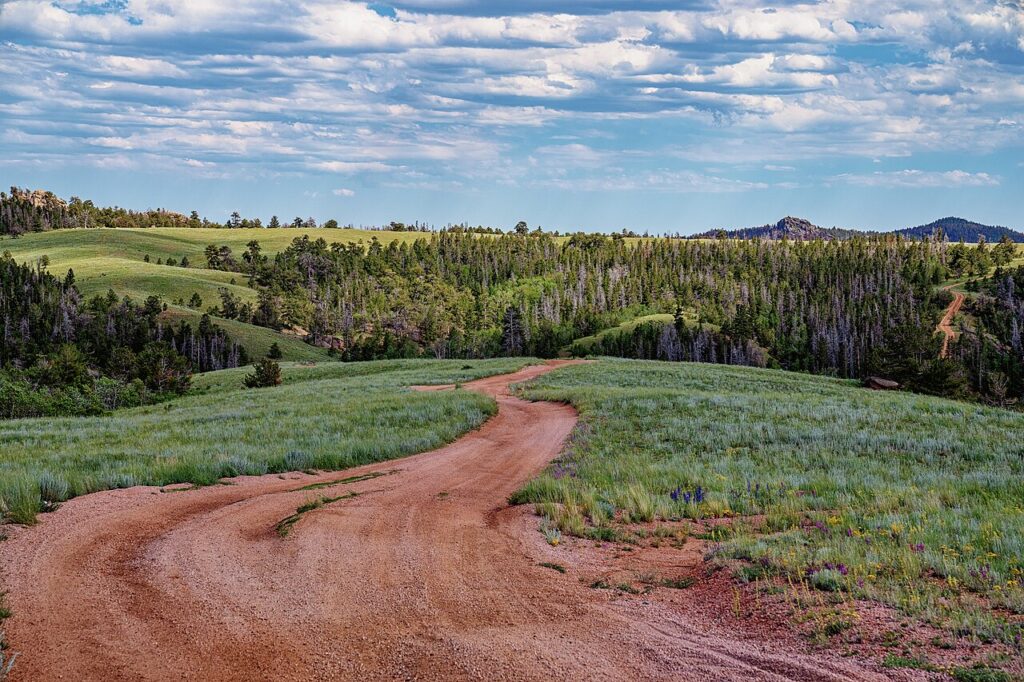
This one’s closer to RJourney territory. Medicine Bow-Routt stretches across southeastern Wyoming and into northern Colorado. The Snowy Range (a spur of the Medicine Bow Mountains) west of Laramie features alpine lakes, 12,000-foot peaks, and the Snowy Range Scenic Byway (Highway 130), which climbs through forest and above treeline in a 29-mile stretch.
Laramie RV Resort puts you about 30 minutes from the Snowy Range Scenic Byway entrance. It’s the kind of day trip that justifies an extra night at camp: drive up in the morning, hike at altitude, and be back at your site by dinner.
State Parks
Wyoming operates 12 state parks and 23 historic sites. The state parks are smaller and quieter than the national parks but often have better camping availability and fewer restrictions.
Curt Gowdy State Park
Located between Cheyenne and Laramie (convenient to both RJourney parks in the area), Curt Gowdy covers 3,596 acres of granite outcrops, pine forest, and 3 reservoirs. Mountain biking trails crisscross the park, and the fishing at Granite and Crystal reservoirs is consistently productive for rainbow trout and brown trout.
Cheyenne RV Resort and Laramie RV Resort are both within 30 to 40 minutes of Curt Gowdy, making it an easy day trip. Pack lunch, bring mountain bikes if you have them, and plan to spend 4 to 6 hours.
Glendo State Park
On Glendo Reservoir southeast of Casper, Glendo offers water recreation (boating, swimming, waterskiing) on a 12,500-acre reservoir surrounded by rolling grassland and cottonwood groves. It’s less dramatic than the mountain parks but genuinely relaxing, and it’s less crowded than most Wyoming destinations.
Boysen State Park
Boysen Reservoir sits at the mouth of Wind River Canyon, where the Owl Creek Mountains meet the Bighorn Basin. The canyon walls rise 2,500 feet from the reservoir surface, and the drive through Wind River Canyon (US-20) is one of the most underrated scenic routes in the state. Geology students come here to read 2.5 billion years of exposed rock layers in a single drive.
Planning Your Wyoming Trip
Where to base yourself
Wyoming’s parks and forests spread across a large state with limited services between them. Choosing a base camp that balances access to multiple destinations saves driving time and keeps the trip manageable.
For Yellowstone and Grand Teton access: The west side of the state (Jackson, Driggs, or West Yellowstone in Montana) gets you closest. These are popular and expensive. Camping reservations inside the parks fill months in advance.
For the Snowy Range, Curt Gowdy, and southeastern Wyoming: Laramie RV Resort, Cheyenne RV Resort, or Pine Bluffs RV Park (the easternmost option, closest to Nebraska Sand Hills and the Pawnee Grasslands). All three sit on the I-25/I-80 corridor, making them accessible and well-positioned for day trips into the mountains.
For the Wind Rivers and western backcountry: Pinedale or Lander serve as gateway towns. Services are limited but the access is direct.
What to pack for Wyoming
Layers: Wyoming weather changes fast. A July afternoon in the Tetons can start at 85°F and drop to 45°F by sunset. Wind is constant at altitude.
Bear spray: Required gear for any hiking in Yellowstone, Grand Teton, or the surrounding forests. Keep it on your hip where you can reach it in 2 seconds. Know the deployment distance (25 to 30 feet). Most outfitter shops in Jackson, Cody, and West Yellowstone rent canisters if you don’t want to buy. Our black bear safety guide covers the rest of the protocol.
Water: High altitude dehydrates you faster. Drink more than you think you need, especially above 7,000 feet.
Sun protection: UV intensity increases about 4% for every 1,000 feet of elevation. At 10,000 feet (common in Wyoming hiking), you’re getting 40% more UV than at sea level. Sunscreen, hat, sunglasses. Not optional.
Frequently Asked Questions
How many national parks are in Wyoming?
Wyoming has 2 national parks: Yellowstone and Grand Teton. It also has 2 national monuments (Devils Tower and Fossil Butte), several national historic sites, and multiple national forests totaling millions of acres of public land. Together, these make Wyoming one of the most public-land-rich states in the country.
What is the best time to visit Wyoming’s national parks?
Late June through mid-September for the best combination of weather, road access, and wildlife viewing. July and August are warmest but most crowded. September offers thinner crowds, fall colors (especially aspens in the Tetons), and active wildlife preparing for winter. Early June can still have snow-closed roads at higher elevations.
Can you camp for free in Wyoming’s national forests?
Yes. Dispersed camping (primitive, no facilities) is free and allowed throughout most of Wyoming’s national forests, including Bridger-Teton, Shoshone, and Medicine Bow-Routt. Rules vary by area: stay limits are typically 14 to 16 days, you must camp at least 100 feet from water sources, and some areas have seasonal closures. For a more comfortable option with hookups and amenities, Cheyenne RV Resort and Laramie RV Resort offer full-service camping near multiple forest access points.
Is Wyoming safe for camping with wildlife?
Yes, with preparation. Wyoming is home to grizzly bears, black bears, moose, bison, and mountain lions. Carry bear spray on all hikes, store food properly (see our food storage guide), never approach wildlife, and keep at least 100 yards from bears and wolves and 25 yards from all other large animals. These are wild landscapes, and the animals have right of way. Respect the distance, and you’ll be fine.
Plan the Trip
Wyoming rewards a basecamp strategy. Pick one home site, drive to a different national forest or state park each day, sleep in the same spot every night. Laramie, Cheyenne, and Pine Bluffs all give you that on the I-80 corridor. Or browse every RJourney park and find the one that matches the trip you’re planning.