You probably won’t see one. That’s the first thing to know about bobcats.
They’ve been watching you since you pulled into the campground. They clocked the squirrel that crossed your site at 4 pm. They know where the rabbits bed down along the tree line. But you’ll almost never see them do any of it.
Bobcats are the most common wild cat in North America, and the most successful at staying invisible. Here’s what campers should know about sharing space with them.
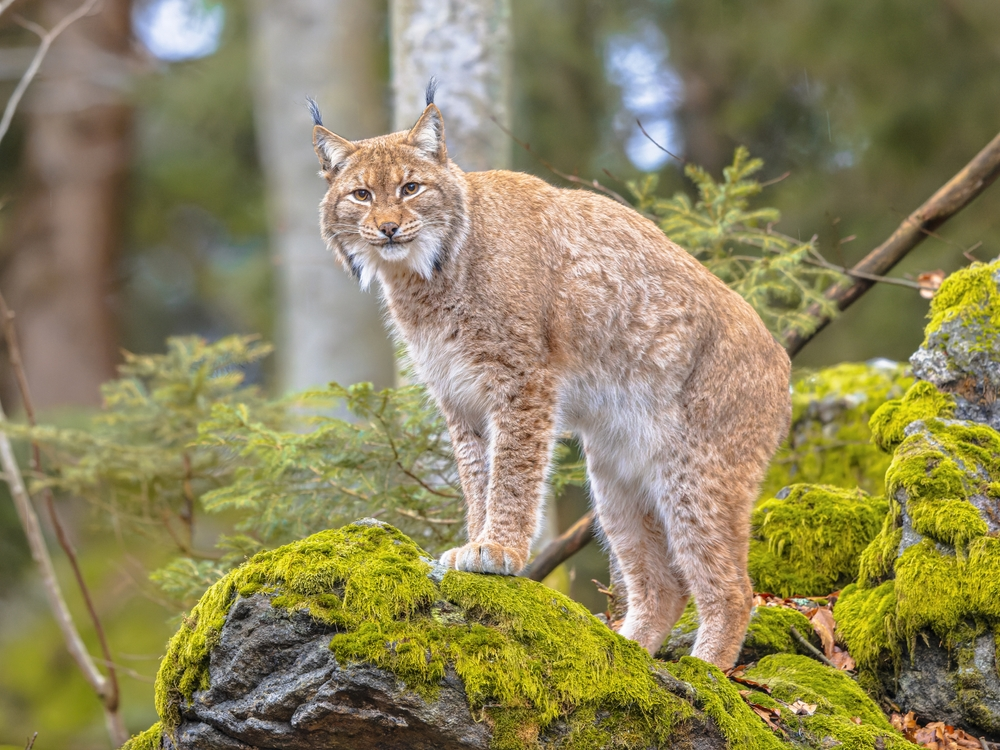
Are Bobcats Dangerous to Humans?
No, in any practical sense.
Bobcats weigh 15 to 35 pounds. An average adult male is about 25 pounds, roughly the size of a large house cat with more muscle and significantly more attitude. Their teeth and claws are built for rabbits, rodents, and birds, not for confrontations with animals 5 to 10 times their size.
Documented bobcat attacks on humans are so rare that the CDC doesn’t track them as a separate category. The Humane Society classifies bobcats as presenting “virtually no threat to humans.” In the handful of recorded incidents, the bobcat was either rabid, cornered (often by a dog), or had been habituated to human feeding.
The comparison that puts it in perspective: you are more likely to be injured by a domestic cat than by a bobcat. A housecat weighing 10 pounds will scratch and bite you if you corner it. A bobcat weighing 25 pounds will be 3 zip codes away before you finished turning your head.
What Does a Bobcat Look Like?
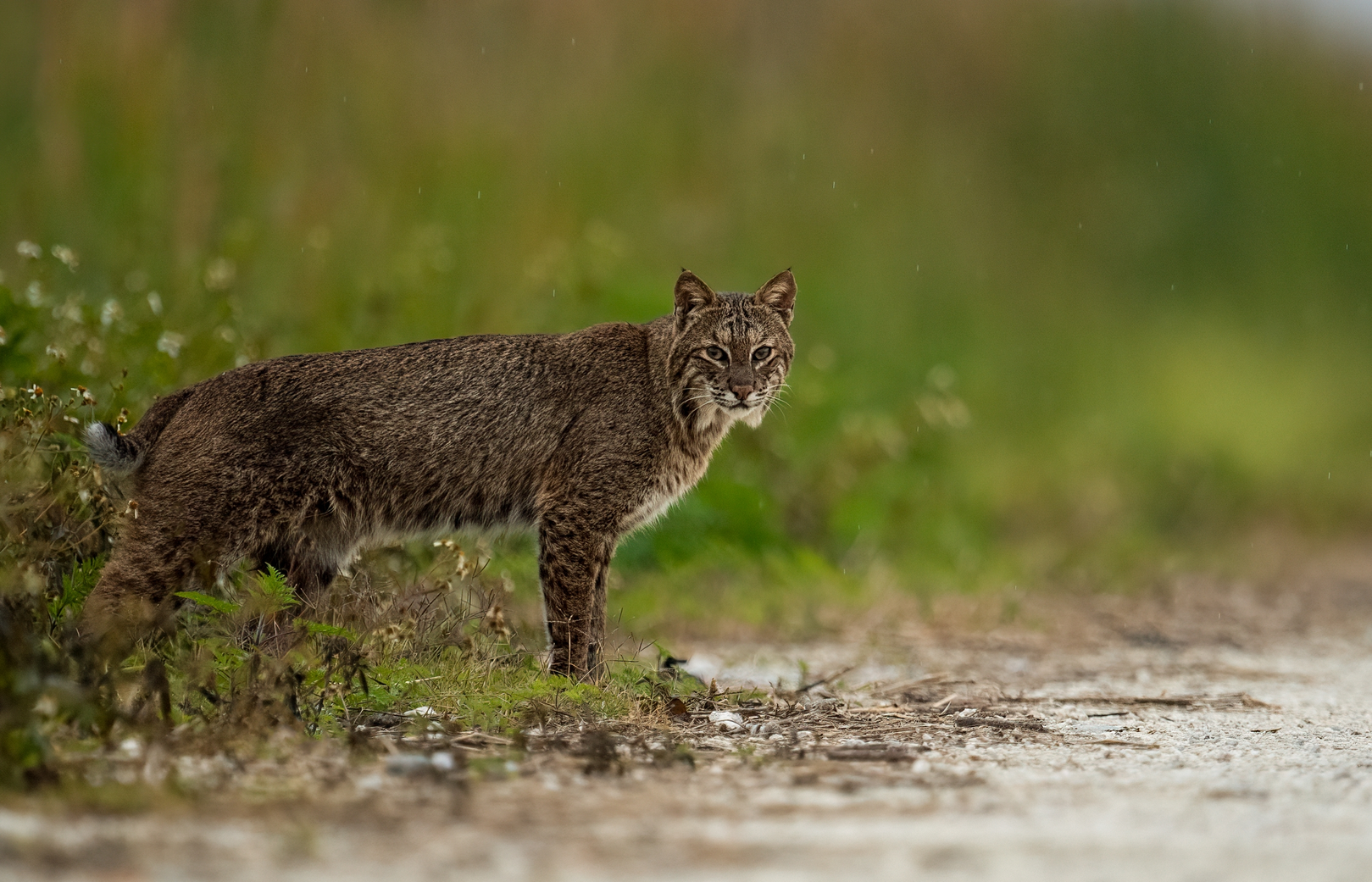
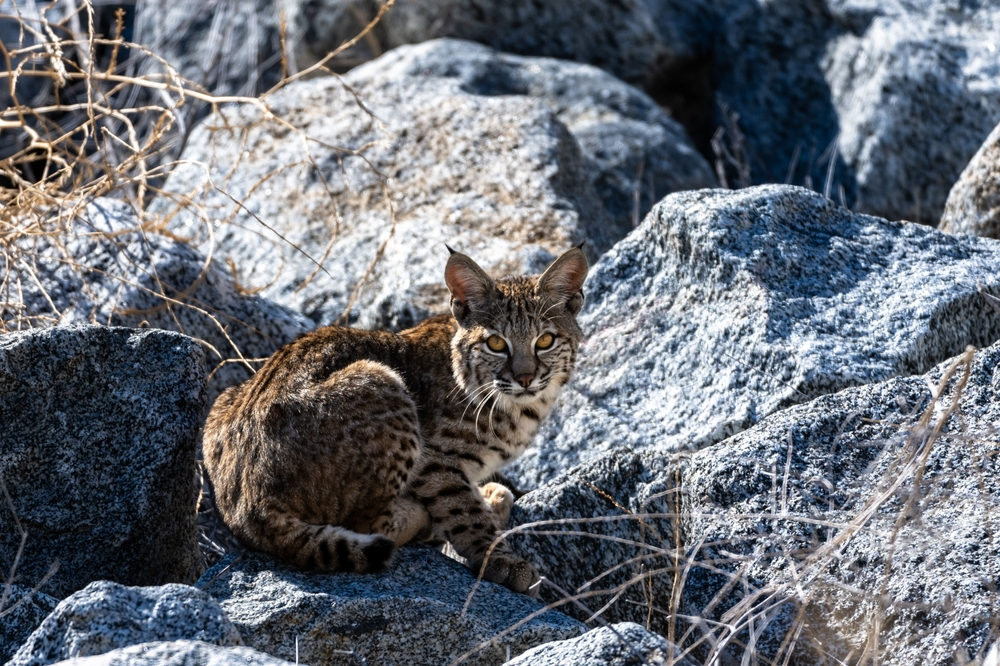
Bobcats are built like compressed springs. Short body, long legs relative to their torso, and a distinctive bobbed tail (3 to 7 inches) that gives them their name.
Key identification markers:
- Tufted ears with short black tips (lynx have longer ear tufts, 1 to 2 inches).
- Spotted or mottled coat in shades of brown, tan, and gray. Pattern varies by region.
- White underside. Black bars on the inside of the front legs.
- Facial ruff of longer fur that extends outward from the cheeks (more prominent in winter).
- Eyes are yellow-green with round pupils that narrow to vertical slits, like a housecat.
The most common misidentification is confusing a bobcat with a Canada lynx. Lynx are larger (18 to 45 pounds), have longer ear tufts, bigger paws (adapted for walking on snow), and solid gray-brown coats without the strong spotted pattern. Lynx range is limited to the northern U.S. and Canada. If you’re camped south of the Canadian border states, you’re looking at a bobcat.
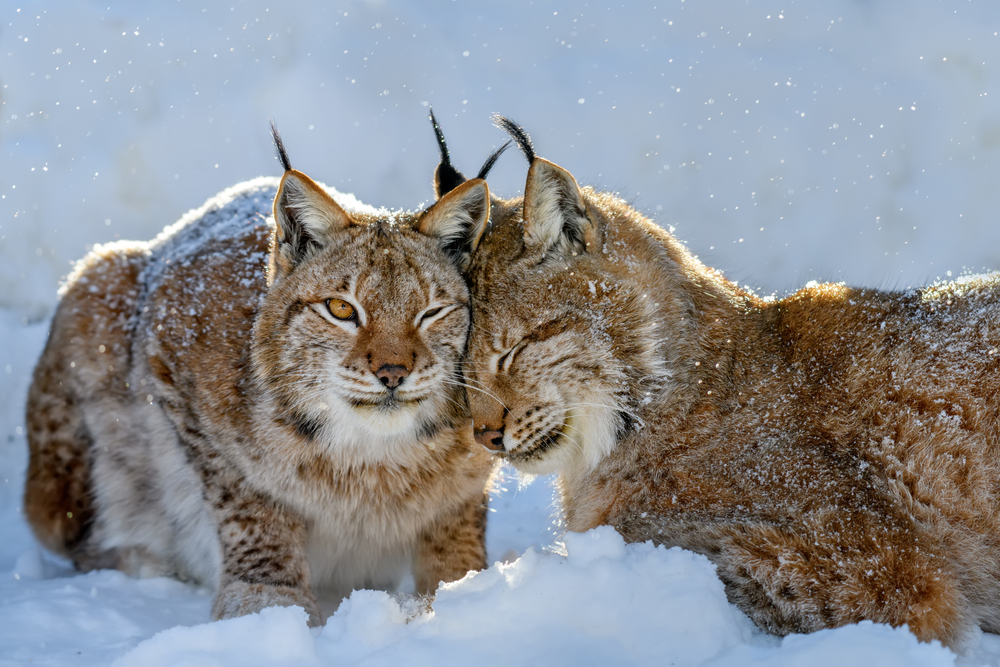
Where Do Bobcats Live?
Every state in the lower 48. Bobcats are one of the most widely distributed wild cats in the world, with an estimated 2.3 to 3.5 million in the U.S. alone.
They’re habitat generalists that favor edges: the boundary between forest and clearing, brush and grassland, creek bed and hillside. Any place where cover meets open ground is bobcat territory, because that’s where rabbits and rodents concentrate.
Desert scrub, Florida swamps, Pacific Northwest rainforest, Appalachian hardwood, Texas brushland, Colorado mountain forest. Bobcats don’t care about the biome. They care about cover density and prey availability.
For campers, this means you’re almost certainly camping in bobcat territory, even if the campground brochure doesn’t mention it. Parks near river corridors, forest edges, and brushy hillsides are highest-probability zones.
When Are Bobcats Active?
Bobcats are primarily crepuscular and nocturnal. Peak activity is the 2 hours after sunset and the 2 hours before sunrise. During those windows, they’re hunting, patrolling territory boundaries, and covering ground.
During the day, they rest in dense cover: rock crevices, fallen logs, thick brush, or the underside of human structures (including, occasionally, the underside of an elevated RV).
Breeding season runs from February through March, and during that period, bobcats are more active during daylight hours. Males range widely looking for females, and females with kittens (born in April or May) are more territorial and less avoidant than usual.
The practical takeaway: if you see a bobcat during daylight outside of breeding season, enjoy the sighting. It’s uncommon and worth paying attention to.
What Do Bobcats Eat?
Rabbits. The answer is almost always rabbits.
Cottontails and jackrabbits make up 60 to 80% of a bobcat’s diet across most of their range. The rest is filled in with mice, voles, ground squirrels, birds, snakes, lizards, and the occasional deer fawn.
Bobcats are ambush hunters. They stalk within 20 to 35 feet of prey, then close the distance in a short, explosive burst. They’re not built for long chases. If the initial pounce misses, they typically don’t pursue.
This hunting style means bobcats require dense cover close to open areas. The campsite with mowed grass surrounded by thick brush? That’s a bobcat buffet layout, and the bobcat knows it even if you don’t.
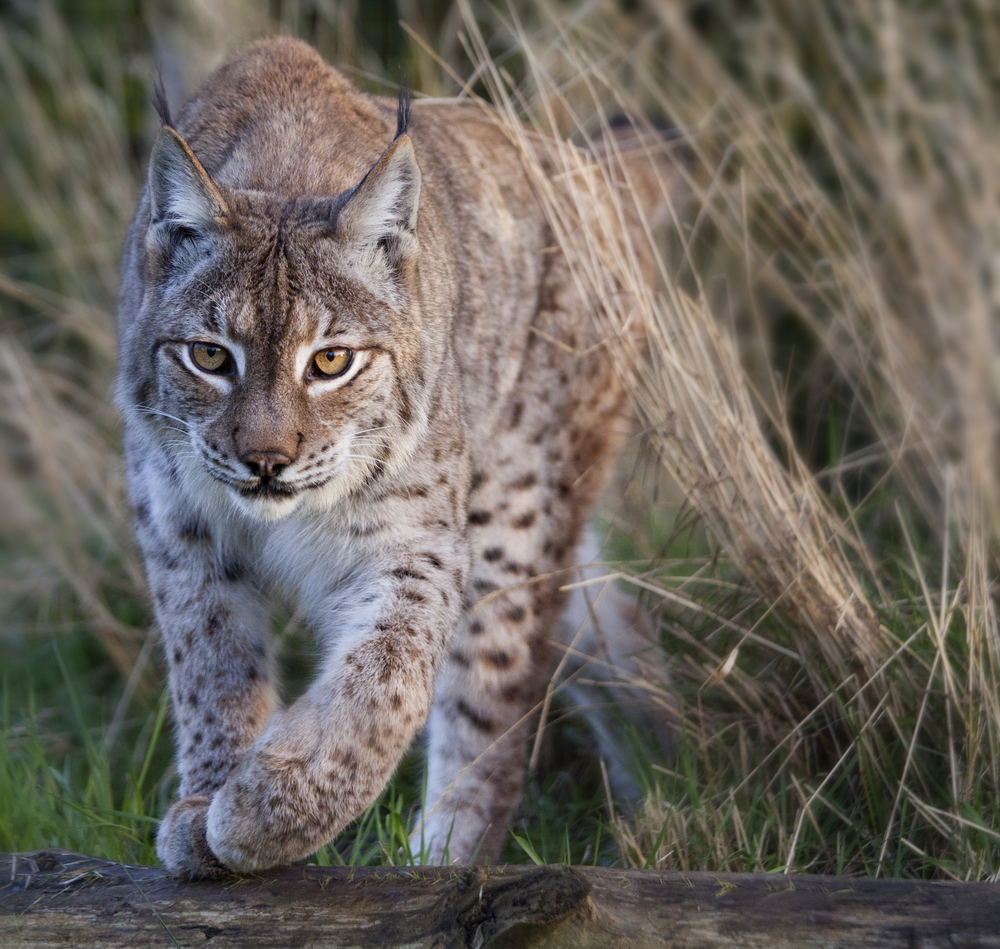
What to Do If You See a Bobcat
First: congratulations. Most people who camp their entire lives never see one in the wild. Bobcats are that good at not being seen.
At any distance:
- Don’t approach. Give the bobcat space and enjoy the observation.
- Don’t turn and run. Running can trigger a prey response in any feline, even one that has zero interest in you.
- Make sure the bobcat knows you’re there. Talk at normal volume. Make slow, deliberate movements.
If a bobcat doesn’t retreat:
- Stand tall. Raise your arms. Clap and make firm, loud sounds.
- Maintain eye contact. Cats use direct gaze as a dominance signal.
- Slowly back away. Don’t crouch down.
If a bobcat acts aggressively (hissing, ears flat, body low):
- It’s likely cornered or defending kittens. Give it an escape route. Step sideways, not toward it.
- If a dog triggered the encounter, control the dog immediately. Most bobcat “attacks” on record involve a dog that treed or cornered a bobcat, and the bobcat fought back.
A truly aggressive bobcat that approaches you unprompted during daylight is potentially rabid. Keep your distance and report it to campground management.
Are Bobcats Dangerous to Pets?
This is the real consideration for campers traveling with animals.
Bobcats can and do prey on small dogs and outdoor cats. A 25-pound bobcat is physically capable of killing any domestic cat and most dogs under 20 pounds. They’re also fast enough (30 mph in a sprint) to close distance before a pet owner can react.
Rules for pet safety in bobcat country:
- Keep cats inside your RV, cabin, or tent. Always.
- Leash dogs, especially at dusk and dawn. A small dog off-leash near brush is at risk.
- Don’t leave pet food outside. Kibble attracts rodents. Rodents attract bobcats.
- Walk dogs on open paths, not through thick brush where a bobcat could be resting.
- Pick up small dogs if you see a bobcat nearby. Carrying a dog immediately changes the size equation.
Larger dogs (over 40 pounds) are generally not at risk. Bobcats prefer easy, quiet kills and will avoid a confrontation with anything their size or larger.
Camping in Bobcat Country
Bobcats are present at most of our parks. You just don’t know it because they’re doing exactly what they’re designed to do: staying unseen.
Sunburst RV Resort in Milton, Florida sits near Blackwater State Forest, the largest contiguous longleaf pine forest remaining in the world. The GM, Layla Massie, says guests photograph “mushrooms and animals” on the property, and the nearby forest offers hiking trails that cut through prime bobcat habitat. Blackwater River runs through the area, and the creek-bottom forest along its banks is the kind of dense, brushy edge habitat bobcats favor. Horseback riding runs just down the road, and the state forest access puts you deep in Florida panhandle wildland.
Lake Charles RV Resort in Louisiana puts you at the edge of the Creole Nature Trail, a 180-mile All-American Road that loops through some of the most wildlife-dense coastal marsh in the country. The GM, Becky Day, recommends the Gator Chateau (where you can hold a baby alligator, 16 miles from the park) and the Creole Nature Trail as must-dos. The marshland and coastal prairie ecosystems along the trail are home to bobcats, alligators, roseate spoonbills, and roughly 400 other bird species. The bobcats here are smaller than their mountain cousins (18 to 22 pounds) and extremely well camouflaged in the marsh grass.
Tunatua RV Resort in Craig, Colorado sits in wide-open northwest Colorado where sagebrush meets mountain forest. The GM, Charleen Peters, describes evenings spent “watching for wildlife” and the “peaceful star-filled sky.” The surrounding public land (Flat Tops Wilderness, Yampa River corridor) supports bobcat populations that prey on the abundant rabbit and ground squirrel populations in the sage flats. Sand Wash Basin, home to Colorado’s famous wild mustang herd, is nearby.
Dolores River RV Resort in Colorado offers river-and-forest camping at the doorstep of San Juan National Forest. The canyon and rimrock terrain between Dolores and Mesa Verde is textbook bobcat habitat: rocky outcrops for denning, brush-choked draws for hunting, and a corridor of riparian forest along the Dolores River. If a bobcat is going to be anywhere near a campground in southwest Colorado, it’s going to be in terrain exactly like this.
Roam Uinta RV Resort in Kamas, Utah backs up to the Provo River, with blue-ribbon fishing spots on the property and the Uinta Mountains rising behind. The ATV trail system (Cedar Hollow trailhead is 1 mile down the road) passes through mountain forest where bobcats den in rock crevices and fallen timber. Mirror Lake Highway starts in Kamas and climbs into alpine terrain where bobcats patrol the tree line.
At all of these parks, the bobcats are going about their business in the margins. The best thing you can do is the same thing you’d do at any campground: keep food secured, pets supervised, and your eyes open at dusk.
Frequently Asked Questions
Can a bobcat jump over a campground fence?
Easily. Bobcats can jump 6 feet vertically from a standing position and 12 feet horizontally. Standard campground fencing doesn’t deter them, but it doesn’t need to. They’re not coming for you or your RV. They’re following a rabbit.
Do bobcats make noise?
Rarely, which is why you almost never hear them. During breeding season, they produce a range of yowling, screaming, and caterwauling sounds that can be startling if you don’t know what you’re hearing. Outside of breeding season, they’re nearly silent. If you hear a loud, strange screaming sound at night in February, it’s probably bobcats, not someone in distress.
Are bobcats aggressive toward children?
No documented pattern exists of bobcats targeting children. Children are still well above the prey size range for a bobcat. Standard supervision practices (keeping kids close at dusk, not letting them approach wildlife) are sufficient.
Do bobcats carry diseases?
Bobcats can carry rabies, feline distemper, and various parasites. Rabies in bobcats is uncommon but documented. The key indicator is behavior: a bobcat that approaches humans during daylight, acts disoriented, or displays unprovoked aggression should be reported immediately.
What’s the difference between a bobcat and a mountain lion?
Size. Mountain lions weigh 80 to 220 pounds with a long, thick tail (2 to 3 feet). Bobcats weigh 15 to 35 pounds with a short, bobbed tail (3 to 7 inches). If you can’t tell which one you’re looking at, check the tail first. For mountain lion safety, see our upcoming guide on camping in cougar country.
Find Your Park
Bobcats have been part of the American landscape for 1.8 million years. They were here before the campgrounds, before the trails, and before the RVs. Camping in their territory is a privilege they don’t know they’ve granted you. Check availability across the RJourney network and find a site where the wildlife is real, and the brush line has a secret or two.