Most articles about camping with kids read like a pep talk. “Get your family outside!” “Make memories!” “Unplug and reconnect!”
Fine. All true. But vague enough to be meaningless.
Here’s what actually happens when kids camp regularly, according to developmental research, pediatric studies, and the accumulated experience of thousands of families who do this every season at RJourney parks across the country.
Physical Health Benefits
Kids move more, and differently
A 2019 study in the International Journal of Environmental Research and Public Health found that children in outdoor recreation settings engaged in 2.5 to 3 times more moderate-to-vigorous physical activity than in structured indoor settings. Camping doesn’t require a coach, a schedule, or a signup sheet. Kids just move because there’s space to move in and things to explore.
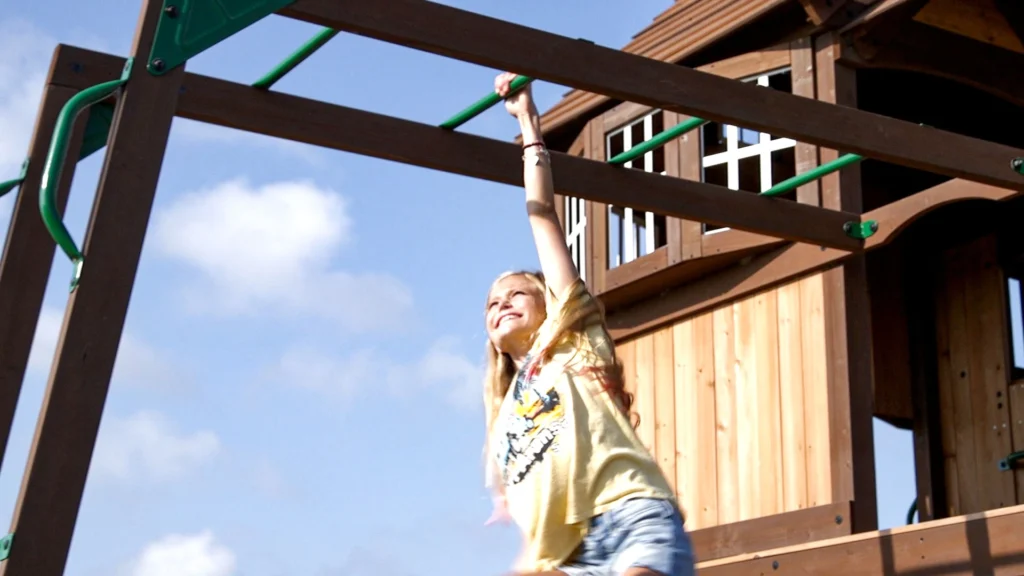
The movement is also different from organized sports. Climbing over rocks, balancing on logs, wading through creeks, carrying firewood. These are compound movements that build coordination, proprioception, and strength in ways that a soccer field or gym class doesn’t replicate. Occupational therapists call this “heavy work,” and it’s increasingly prescribed for kids who struggle with sensory regulation.
Sleep resets
Camping recalibrates circadian rhythms. A study from the University of Colorado Boulder published in Current Biology showed that just one weekend of camping (exposure to natural light cycles and no screens) shifted participants’ melatonin onset by roughly 1.4 hours earlier. For kids who’ve drifted into late-night screen habits, a camping weekend can physically reset their sleep clock.
It’s not magic. It’s light exposure. Daylight is 400 times brighter than indoor lighting. Your body responds by anchoring its internal clock to sunrise and sunset. Two nights in a tent can do what weeks of “put the iPad down” negotiations can’t.
Immune system exposure
The “hygiene hypothesis,” now more accurately called the “old friends mechanism,” suggests that children who have regular contact with diverse microbial environments develop more resilient immune systems. Dirt, pond water, tree bark, campfire smoke. Camping exposes kids to microbial diversity that sanitized indoor environments simply don’t provide.
This doesn’t mean letting kids drink creek water. It means that hands-in-the-dirt outdoor play builds immune tolerance that researchers increasingly link to lower rates of allergies and autoimmune conditions in adulthood.
Mental and Emotional Benefits
Stress reduction is measurable
Cortisol levels drop in natural settings. A meta-analysis published in Environmental Health and Preventive Medicine reviewed 64 studies and found consistent reductions in salivary cortisol, heart rate, and blood pressure during and after nature exposure. The effects are stronger in children than adults.
You can see it at the campground without measuring cortisol. Kids who arrive wound up from the drive tend to settle within an hour of being outside. By the second day, the pace changes visibly. Less whining, less screen-seeking, more self-directed play.
Boredom becomes productive
There’s a moment on every camping trip, usually about 4 hours in, when a kid says “I’m bored.” This is the moment most parents dread and the moment child psychologists celebrate.
Boredom is the precursor to creativity. When kids can’t scroll, swipe, or switch to something pre-built, they invent. They build stick forts. They create games with pinecones. They decide to see how many different bugs they can find and make a field guide. Dr. Teresa Belton at the University of East Anglia has published extensively on this: children who experience and resolve boredom develop stronger creative capacities than those who are continuously stimulated.
Your job as a parent in this moment: resist the urge to solve it. Give it 20 minutes. Something will emerge.
Confidence through competence
Camping gives kids real tasks with real outcomes. Not worksheets. Not simulations. Actual problems that need solving.
Starting a campfire (with supervision). Setting up a tent. Reading a trail map. Identifying which berries are safe and which aren’t. Cooking a meal over coals. Each of these builds what developmental psychologists call “self-efficacy,” the belief that you can handle challenges. It’s the most reliable predictor of resilience in children, and experience is the only thing that builds it.
For a step-by-step guide to teaching kids campfire skills safely, see our campfire building guide.
Social and Family Benefits
Shared challenge bonds families
Family therapist Dr. Michael Ungar has written that shared adversity (even mild adversity, like setting up camp in the rain or cooking dinner over a fire that won’t cooperate) strengthens family cohesion more effectively than shared leisure. Camping provides low-stakes adversity in abundant supply.
The tent pole that won’t cooperate. The meal that’s slightly burnt. The rainstorm that hits at 2 AM. Each one becomes bonding material the moment it’s over. Families that camp together build a shared narrative of “remember when we…” stories that become family identity over time.
Kids learn to socialize outside their bubble
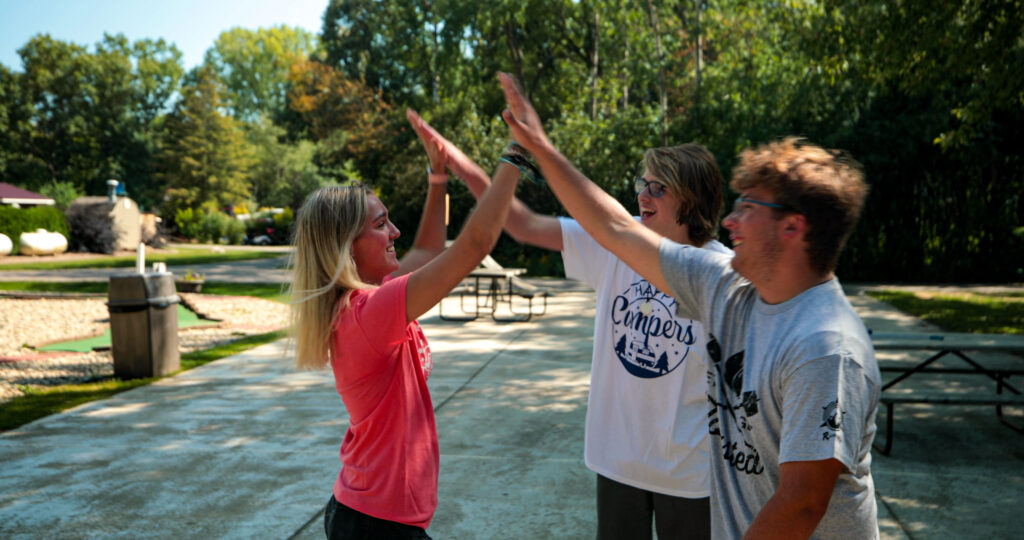
Campgrounds are natural community spaces. Kids from different states, different backgrounds, different ages end up riding bikes on the same loop road, throwing rocks into the same pond, and asking if they can roast marshmallows at each other’s fires.
This kind of unstructured, cross-age socialization is increasingly rare. Schools group kids by exact age. Organized activities sort by ability. A campground doesn’t sort at all. A 7-year-old and a 10-year-old figure out how to play together because they’re both there. That negotiation, the figuring-it-out, is a social skill that no structured program teaches as well.
Screen time drops without a fight
You can try to limit screen time at home. You’ll get arguments. At a campground, screens become irrelevant because there’s something better to do. The American Academy of Pediatrics recommends children ages 6 and older have “consistent limits on the time spent using media,” but every pediatrician will tell you the same thing: replacement works better than restriction.
Camping replaces screens with something genuinely compelling. Better options do the work that willpower and rules can’t.
Age-by-Age Guide
Babies and toddlers (0 to 3)
Start now. Seriously. Toddlers don’t need a five-star campsite. They need dirt, sticks, and a parent who’s present. Keep trips short (1 to 2 nights), bring familiar bedding, and accept that nap schedules will flex. The payoff: early exposure to outdoor environments builds comfort that compounds over years.
Practical tip: RV camping is significantly easier than tent camping with a toddler. Climate control, a familiar sleeping space, and a real kitchen make the logistics manageable. Family-strong RJourney parks like Pearl Lake (Redgranite, WI) and Splash Magic (Pennsylvania) have pull-through sites and clean amenities that simplify the setup-with-a-toddler juggle.
Preschoolers (3 to 5)
This is the golden window. Preschoolers are old enough to explore but young enough that a campground feels like an entire world. Nature walks, bug hunts, rock collections, puddle jumping. Every activity is an event.
Practical tip: Assign one real camp job. Gathering kindling. Carrying the water jug. Stirring the pot. Preschoolers who have a job feel included and important, and they’ll talk about it for weeks.
School age (6 to 12)
Expand the range. School-age kids can hike longer distances, learn to fish, help cook real meals, and start handling campfire responsibilities with supervision. This is also the prime age for wildlife awareness conversations, turning encounters with birds, deer, or even a raccoon at the cooler into genuine learning moments. (For the bigger animals, our black bear safety guide is a worthwhile read before a Western trip.)
Practical tip: Give them a field guide (birds, trees, tracks) and a cheap pair of binoculars. Self-directed nature exploration at this age builds the kind of curiosity that translates directly into academic motivation.
Teens (13+)
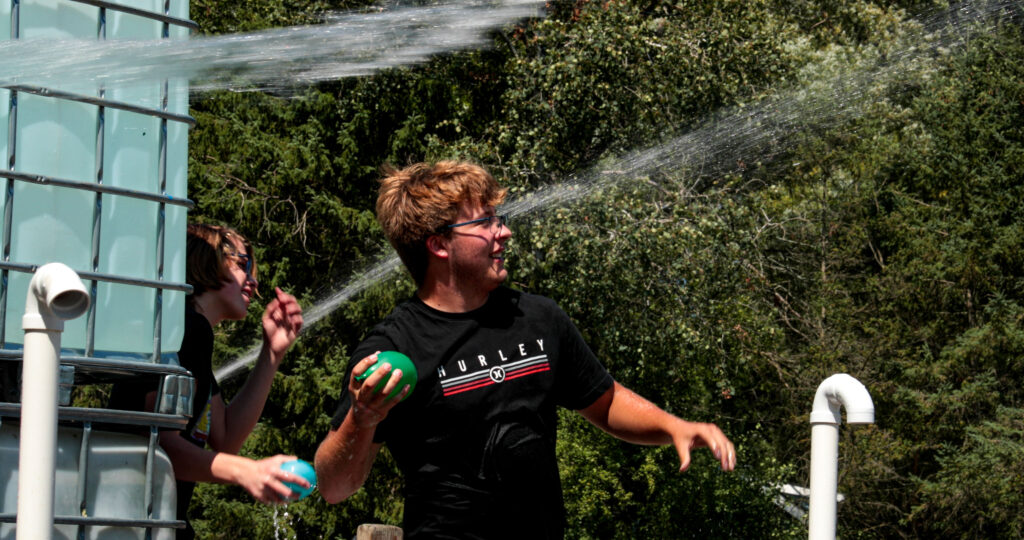
Teens are harder to impress, and that’s fine. The benefits shift from novelty to responsibility. Let them plan the route. Put them in charge of a meal. Give them a hammock and a book and leave them alone for an afternoon. Teens need autonomy, and a campground is a safe place to practice it.
Practical tip: Invite them to bring a friend. A teen who’d roll their eyes at “family camping” will often say yes if a friend comes along. The family bonding still happens; it just happens differently.
Getting Started: First Camping Trip Checklist
You don’t need to invest thousands of dollars or drive to a remote wilderness to get the benefits. A weekend at a well-equipped RV park or campground is enough.
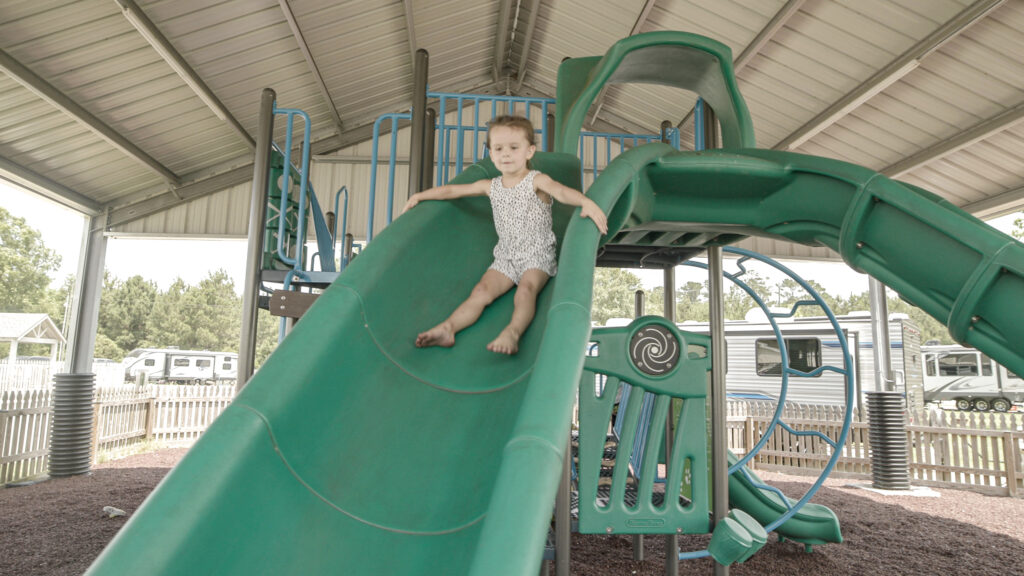
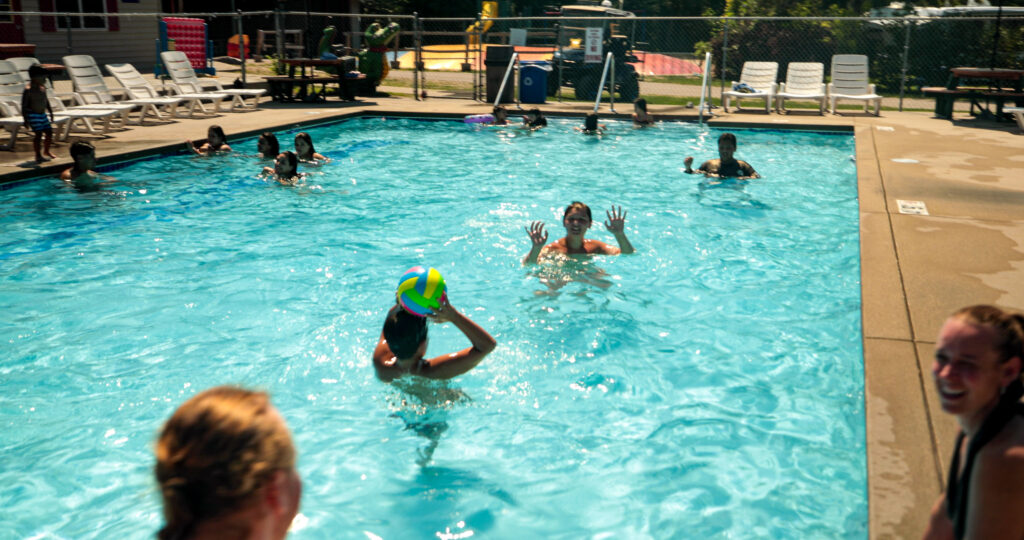
Pick the right park: Family-friendly campgrounds with amenities (pool, playground, clean bathrooms) reduce friction for first-timers. The aqua parks at Coconut Cove and Baraboo (both Wisconsin) and the water slides at Splash Magic (Pennsylvania) all give kids a comfort anchor on day one. Fish Lake Beach in Volo, IL has been a generational family park for 85 years. Or browse the full list of RJourney parks and filter for what your family needs.
Start with 2 nights: One night isn’t enough. The first day is setup and adjustment. The second day is when the benefits kick in. Two nights is the minimum effective dose.
Lower your expectations: The first trip will have hiccups. That’s fine. The tent might leak. The kids might complain. Dinner might be cereal because the stove didn’t cooperate. None of that erases the benefits. It just adds to the “remember when” stories.
Plan one activity, leave the rest open: Over-scheduling a camping trip kills the unstructured exploration that makes it valuable. Plan one hike, one fishing session, or one campfire cooking session. Then let the campground do the rest. (And if you’re packing the cooler, our camping food storage guide covers the cold/wildlife angle.)
Frequently Asked Questions
What age is best to start camping with kids?
Any age works, but the earlier the better. Toddlers as young as 12 to 18 months adapt well to short camping trips, especially in RVs where the sleeping environment stays familiar. The real “golden window” for maximum wonder and engagement is ages 3 to 7, when kids are mobile enough to explore but young enough that everything outdoors feels extraordinary.
How do I keep kids safe while camping?
Establish clear boundaries (how far they can roam), teach basic wildlife awareness, apply sunscreen and bug spray regularly, ensure everyone has water shoes near rivers and streams, and keep a first aid kit accessible. For specific wildlife precautions, see our guides on black bears and raccoons. The biggest safety factor is adult presence without hovering; kids need space to explore with a grown-up nearby.
What if my kids hate camping?
Give it more than one trip. Most kids who “hate camping” are reacting to unfamiliarity or one bad experience. Choose a campground with a pool or playground so there’s a comfort anchor. Bring one comfort item from home. And resist over-structuring the trip. Kids often warm up to camping when they’re given freedom to explore on their own terms, usually by the second morning.
Is RV camping as beneficial as tent camping?
Yes. The benefits come from being outdoors, sleeping on natural light cycles, engaging in unstructured play, and spending uninterrupted time as a family. Whether you sleep in a tent, a cabin, or an RV doesn’t change those fundamentals. RV camping actually removes logistical stress (weather, cooking, bathrooms) that can make tent camping with young kids more difficult than fun.
Plan the Trip
The best first family camping trip is the one that’s already on the calendar. Pick a park with a pool or aqua park so the kids have a soft landing on day one, then let the unstructured part of the trip do the heavy lifting. Find an RJourney park and check availability for the weekend you can actually make work.